Monday, 16 April 2012

Thoughts on film comedy

 Eventually all of my thoughts on comedy come back to Old Charlie and his spiritual successor Jacques Tati. Charlie's birthday gives me the perfect opportunity to write about comedy, via his ideas.

Anecdotes:
Chaplin had a gift for expressing his vision of comedy with superb economy. I found two anecdotes in his autobiography that seem relevant.

Charlie in his non-Tramp persona.
The first is a hypothetical scenario: a man goes to a funeral. Everyone is standing. The man keeps his hat on a chair beside him. When everyone sits down, the fellow next to our man sits on his hat without noticing it. No one else has paid any attention to this little incident, but between the two of them the sombreness has been lost. I have no idea if Tati ever read Chaplin's autobiography but there's a reenactment of this in M. Hulot's Holiday. The ever-bumbling M. Hulot happens upon a funeral when his car breaks down. Dry leaves stick to one of the spare tyre-tubes in his jalopy. One of the attendants at the funeral takes it for a wreath and places it by the corpse's side. As upper-class mock-sombre people pass by the deceased in a file, air leaks from the tube and the "wreath" droops. The spell of seriousness has been broken.

The second is one of Chaplin's childhood memories: a flock of sheep are crossing by his house. This delights the kid to no end, until he realises that they are being led to the neighbourhood slaughterhouse. Comedy and tragedy often live with each other in an uneasy space.

Statement:
Tati!
Which bring us to Chaplin's most memorable quote: "Life is a tragedy in close-up, a comedy in long shot." Virtually all comedy - and not just the distinctively visual comedy practised by the likes of Charlie and Tati - has its essence in that one line. In a strictly visual interpretation it is probably best summarised in Tati's Playtime - a film of magnificent ambition where every frame has multiple gags being played out in various planes in the foreground and background, often contrasting each other, sometimes creating a sort of magical symphony. Needless to say everything is in long-shot - most of the film's situational humour is derived from the fact that the players are lost in their own internal worlds, unaware of the other players in the frame, whereas we can see all of them at once. A classic example is the scene where Tati's M. Hulot goes to an old army friend's house - an glass-walled apartment building where every movement can be seen from the streets. While the army buddy undresses, we can also see his female neighbour watching TV. The resulting visual gag suggests that the lady is seeing the man strip!

Visual interpretations aside, all black humour also relies on the same principle of the larger picture undercutting the smaller one. Consider Dr. Strangelove. In the scene where Bat Guano is sent to Burpelson Air Base to get to Jack D. Ripper, he's confronted with Mandrake. Mandrake assures Guano that he knows that Ripper's commands mean nuclear annihilation, and only he can stop it if he can put a call through to the US President. The phone booth requires loose change - and since no one has the required amount to place a call to the President - Mandrake suggests Guano blast the Coca Cola machine and get some. Which prompts Guano's much-quoted rebuttal, "That's private property. You'll have to answer to the Coca Cola company!" As in Tati, our previous knowledge of imminent nuclear disaster provides this banter-driven scene the darkly comic tone it is remembered for.

Saturday, 7 April 2012

Dashboard confessional

Part-confession, part-rationalization. How are your cultural preferences formed?

My gateway to 'artsy' Indian cinema was Satyajit Ray (like most people) - and now having travelled across the cinematic landscape of the country to some extent, and having seen some of the other world-class Indian directors - I'm still fixated with the man. If I were to name one Indian film that is the closest to me, it's Ray's Pratidwandi (The Adversary, 1971). But why - are there not more quintessentially "Indian" directors? (Mani Kaul?) Or even "Bengali" ones - like Ritwik Ghatak? Kaul's films draw upon all sorts of Indian arts in a way Ray's straight-faced realism does not. Ghatak's preferred style of acting is closer to jatra - or popular Bengali theatre - than the naturalism favoured by Ray. As is his use of grand melodrama - territory which Ray avoids as much as he can, his preferred tone being one of subdued emotion.

The answer which I've arrived at with much exploration and rationalization is this: the preference is simply a projection of my own personality (intuitive in retrospect, but... you know!). Avidly listening to Western Classical Music from a very young age, rejecting traditional religion, having an initial distaste for the sentimental aspects of the quintessential Bengali character - Ray made an outward journey from his home. He soaked in Western culture without feeling threatened by it, no doubt a result of an urban cosmopolitan upbringing. And then he sort of made the journey back home once he started with his painting course at Shantiniketan: discovering the rhythm of rural life, seeing traditional Indian art with new eyes.

Compare this with Ghatak's journey: born into pre-Partition Bangladesh with agriculture still not in decline, spending his childhood in a land of plenty, only to be ripped apart by a harsh reality and thrown into an urban maelstrom called Kolkata. A journey away from home, here too, but one undertaken without will. All of Ghatak's films - with the possible exception of Ajantrik - is therefore a pining for the home he'd never get back.

These trajectories matter because everyone - except those who are superhuman - looks for personal resonance in whatever they see, read, listen to, argue about et al. My own journey goes something like: ordinary pop culture devouring for about the first 17 years of my life, then a slowly growing appreciation of foreign cinema and rock music (Western!) and finally a search for roots - discovering and appreciating homegrown culture, primarily through artists like Ray (in cinema), Indian Ocean and Prasanna (in music) who have a foot each in both the home and the world (ghare-baaire).

Why do I feel the closest to Pratidwandi? In Siddhartha lies the closest portrayal of my own self in cinema - idealist, dreamer, pragmatist and someone doomed by character to see both sides of any question.

So the next time you're wondering aloud why I prefer the insider-outsider instead of the more authentic "Indian", you know it's a result of my own limitations. Only someone who has ventured outside and returned home with some ambiguity about rootlessness resonates with another in the same spot.

P.S.: Objectively speaking, if that can mean anything at all, there are directors, musicians, authors etc. whom I admire more from a somewhat neutral, detached vantage-point. But if you're talking about personal resonance, it is what it is.

P.P.S.: The Blogger GUI is called a dashboard, hence the title. No allusions to the band.

Friday, 23 December 2011

Flights (of fancy) in chroma key

Malegaon Ka Superman with his heroine, dancing.

A novice in the world of filmmaking wonders how an essentially collaborative art succeeds in projecting a single vision - the director's. Not a cine-hippie with some reading of the auteur theory. A cloth-store owner, living in a remote town of Maharashtra, whose dreams are the stuff of cinema. Nasir Shaikh. Director of Malegaon Ka Sholay - the comedy remake of India's biggest blockbuster which became a runaway hit in its own targeted market. Having conquered the peak of India's commercial film industry in his own way the next step in his evolution is, of course, making a Hollywood-derived film. Malegaon Ka Superman.

Boasting the biggest budget ever Shaikh has worked with (about a hundred thousand rupees), he has decided to upgrade the "technique" in this film. Superman will fly - a feat which will be achieved by chroma keying. Played by an undernourished hand in a power loom (weaving is Malegaon's primary industry) called Shafique, Malegaonwale Superman seems earnestly determined to move onto bigger roles. His daredevil feats involve painfully balancing his body on bits of wood and bullock carts, jumping into cold water inspite of not knowing swimming (the kids he's meant to save somehow haul him up on land) and performing stunts that usually end up hurting him a lot more than the villains he's beating up (all of them have better physique). Production problems dog the filmmakers at every step - actresses are rare because Malegaon's conservative society does not permit girls to step out of their houses, the camera falls into water and nearly goes dead and Superman-ji is married off in between the shooting. Falling behind schedule means cost overruns - now here's something that connects the most frugal of film industries with the bulkiest and most moneyed. And yet Nasir is egged on by his love of cinema and the sheer joy of filmmaking to overcome these and stay cool.

Superman and I'm-in-trouble-man fly together. And yes, Superman wears uber-cool Hawaii chappals.
The insights are many. One of the screenwriters, Akram Khan, confesses how he started out thinking he'd write with his heart and yet how the final product is mathematical (to use his own word): coldly calculated bits of comedy, anti-climax, climax, action, songs, the works. In other words, the story of almost every commercial filmmaker who had set out with personal visions and slowly gave them up for success (there are echoes of this sentiment in a Dibakar Banerjee interview where he says how he too has been corrupted by the money-making machinery). And then the equally candid confession that only 20% of the original script and vision remains in the final product - in this Akrambhai only differs with Nicholas Ray, a far more rebellious and adamant fellow, in the numbers (Ray said 50%).

There are revelations which quietly seep through the cracks - the heroine of Shaikh's film talks about the strict restrictions on the womenfolk of Malegaon, how girls from outside town (like her) have to be hired at high rates ( she takes 1000 a day whereas the hero takes about a 100) to do the dances, love scenes and climaxes. In the midst of her interview, her phone rings - we deduce it's her boyfriend from the hushed tone, a confirmation comes when we hear several covert mwahs. A village elder comes to the shooting location, sees hero and heroine hoisted on wooden planks (they're shooting the couple-flying-together scene) and turns his eyes away from the blasphemous sight.

Then there's the near-ubiquitous talk of moving on to the bigger game - Bollywood. Everyone in Mollywood (for that is the name of Malegaon's direct-to-video film industry) has upwardly mobile dreams. Except Nasir Shaikh, whose dedication to family matters is absolute - the reason why he dissuades his younger (and equally cinema-crazy) brother from venturing into filmmaking. Someone needs to earn for the family. If one brother is indulging in his passions and losing money, the other must make up. The business is exhausting and unrewarding. An echo of Billy Wilder telling his audience that he'd prefer his son not to be a filmmaker - "it's too goddamn painful."

The film is completed and Shaikh re-opens his long-dead video parlour (where he learnt by watching the greats, as he says - Chaplin, whose Modern Times and City Light [sic] are in his collection; Arnold Schwarznegger, Jackie Chan, et al.) for a screening. Initial reactions are encouraging. Luck favouring the brave, Nasirbhai will probably move on to bigger projects. In Malegaon. Even if his crew moves to Mumbai.

Supermen of Malegaon (documentary), dir. Faiza Ahmad Khan, 2008.

P.S.: The film will have a second screening at Rabindra Sadan, 6 PM, 27th December '11 as part of the Kolkata International Children's Film Festival. Catch it if you can. More than a few guffaws guaranteed!

Tuesday, 15 November 2011

In praise of a loser

I've been meaning to write a big, fat Indian Democracy post after recently finishing Ramachandra Guha's India After Gandhi, four years too late. Thankfully, that initial enthusiasm has subsided - thereby saving every one of my readers (?) from that familiar know-it-all (or at least, know-it-enough) feeling.

The present post relates in, some sense at least, to democracy. It concerns a subversive musical-comedy that grabbed attention some months back with a couple of provocative trailers (NSFW).

The director of Gandu - Q - made an interesting documentary called Love in India (trailer) a couple of years back, which dealt with India's attitude towards love and sexuality. Love in India showed how Hinduism's mythical past is rife with innuendo, at ease accepting sexuality, even worshipping it - a practise which seems to have been shunned or sanitised by mainstream religion (though it survives in several folk, pagan and tribal customs). In the course of making his film, Q interviews an interesting cross-section of people - Nabanita Dev Sen (who tells us that our simultaneous acceptance of Radha-Krishna's illicit affair and the sanctity of marriage reveals a dichotomy - most hilariously manifest in what many of my college friends do: watch porn while maintaining a conservative stand on women having multiple relationships), several of Q's friends and relatives, married couples, folk singers, artistes and a distributor of B-grade films. The last gives one of the film's joyous, most cheerful testimonials. He describes how he sees many middle-aged women in seedy theatres, finding the cheap sleaze revolting, doing "chhee-chhee" and facepalms; but still stealing glances. That, he says, is definite proof of the elemental appeal of sex - even as we are ashamed of it, we just love it.

This provides us with a starting point in understanding Q's follow-up to Love in India. Kanti Shah - India's Ed Wood, our greatest peddler of lo-fi sleaze - makes films whose thematic concerns are trivial, but absolutely essential if we want to understand India's attitude towards sexuality. The Kanti Shah Woman is a prototype - who dresses vulgarly, usually beds all of the male characters in the film and ultimately pays for her sins with death (usually at the hands of some virtuous male character who was swayed and seduced by the vamp's charms). Film after film, this prototype is repeated, as is the plot. However, there is no explicit sex - the most daring bed scenes involve obese males unnaturally fondling young women accompanied by lots of panting. Most notably these films are never denied a CBFC (Censor Board) certificate.

But Gandu has been denied one. Q has been adamant about not bypassing the censor board and releasing the film directly onto the net because he wants to take the system head-on (there are repeated requests for downloads on Gandu's Facebook fanpage which have been denied by Q). I think he's still hoping and fighting for a mainstream release. When the Naya Cinema festival of Mumbai wanted to screen Gandu, they expected trouble from conservative political factions and applied for police protection. They were denied.

This selective pattern of denial recalls the sanitisation of our myths pointed out in Love in India. Sex is okay for public consumption when it is couched in vulgarity (lesson: "promiscuous girls are vulgar as well") and chastised by a twisted morality (the vamp dies, the moral universe remains untouched); but not when it is direct, naked, celebratory.

Meanwhile Gandu has been released on torrent in a Preview Copy stage (basically, without the sharpness and colour density of the original). My guess is that the makers released it themselves, just to keep the over-eager audience placated. The reaction from my peers, generally speaking, has not been good. Those whose interests were piqued by the trailers were disappointed by the film's lack of a clear narrative arc (usually expressed as "where is the story?") and its irredeemable protagonist.

It is worth recapitulating our mainstream A-grade cinema's attitude towards sexuality and transgression for a change. Bengali cinema has had its fair share of "grittiness" recently, but in 9 out 10 cases where degenerate behaviour has been shown - the character has been given some sort of a victim motive. Sexuality has been touched, but mostly safely - the recent Baishey Srabon showed a couple living in, but their love was all about rolling around aesthetically wrapped in bedsheets and (then a direct cut to) a post-coital smoke.

The real departure Gandu makes from its precedents is not so much in what taboos it has broken, but in the way it has. Contrary to allegations, the film does have a story  - young boy doesn't like his fucked-up existence, finds a friend in a rickshaw-wallah, and escapes in drug-trips - but its protagonists are far removed from any of the cushioning comforts usually offered by mainstream cinema. True, Gandu - the protagonist - suffers from a victim complex, but his actions far exceed any justified reaction to his environment. The extended full frontal sex scene is not a wimp trying to forget his sorrows in lovemaking, just a sexually liberated guy trying to top his trip. The film's numerous rap numbers are wickedly humourous - personally speaking, they were more than enough compensation for the occasional indie film hipness - and work excellently as subversive critiques of our socio-cultural values. The very lack of dramatic narrative works as subversion of our demand of a "story".

The Indian Constitution gives us the right to freedom of speech, but qualifies it with the clause that one cannot cause offence to anybody. This, in effect, nullifies the right. (I am offended that people take their right to be offended as the right to ban the offensive.) Gandu is just the sort of litmus test India must pass if it is to remain a democracy.

P.S.: An interview with Q which throws good light on the sort of films he believes in. Also, I hope some people will go ahead and check out Love In India. Punk art is awesome, alright, but it's better to see things in a calmer state of mind.

Friday, 28 October 2011

A shout out for internet pirates!

A new bill called the E-PARASITE act is being debated in the US House which will give governments, courts and corporate biggies the power to shut down any website which is infringing on their copyrights (of course, according to their own decisions). This is even worse than the existing legislation that allowed websites to take down content deemed copyright-infringing and save itself from legal action. In effect, anything the overlords want us to pay for, we have to - if we really want to use it.

I'm going to argue against this mainly from my vantage point: i.e. as someone in a modest Indian town with a deep interest in matters of the world, and especially, cinema. It is no big secret that Indians don't have even middling-decent DVD rentals or arthouses where one can pay agreeable money to watch a decent variety of cinema. The local DVD rentals in my place keep only safe bets: blockbusters from Tolly, Bolly and Hollywood, a huge stock of b-grade Hindi and Bengali cinema (which, surprisingly, has a steady market), a nominal amount of "art cinema" (the big names in Bengali would be something like: S Ray, Aparna Sen, Goutam Ghose etc.) and large stocks of porn. Kolkata is somewhat better off than Durgapur, of course, but one only gets the theatre experience when the odd film festival comes to Nandan (not counting private screenings). The stores in Kolkata are also somewhat better off - I frequent the Music World on Park Street just to check out what titles they have on the shelves - though they usually keep the Certified Classics only. Thankfully, they're getting somewhat brave and bringing some rarer stuff - besides the usual Kurosawa, Bergman, Truffaut, Fellini et al - I've spotted the odd Olmis and the Dardennes. The gist is this: for a young, impressionable student in Durgapur/Kolkata interested in cinema, the options of getting a steady and healthy supply are still underdeveloped.

Now, let's do some preliminary mathematics to show why the internet saves me from film-ic ignorance. Due to the recent boom in telecommunications, even a mofussil like Durgapur has excellent broadband connectivity. And for around 800 to 1000 rupees, one can get a connection with no limits on data transfer. Basically, a 'free' ticket to share whatever files you want to. Thanks to a very well-developed file sharing web on the internet, I have access to whatever cinema I want. Everything from 1920s German horror to the latest film playing on the festival circuit is within reach if you have found your way around the net. So whereas I can only get three or four DVDs at most with a 1000 per month, I can (and do) download somewhere around 20 to 25 films with the same outlay.

Does this mean I won't buy DVDs at all? I will, but only a few I have already seen and loved - and when I have the money to spare. The way I see it, I'm not cutting down on the business of the corporations at all: it's a choice between not being able to buy and not buying it. My question is - why should an artiste mind if he's reaching out to a wider audience? As far as I know, corporations take the major chunk of sales profits anyway. For the artiste it's a choice between a little more money from royalties and sales profits (and that too is debatable: most filesharing proponents won't buy stuff as heavily as they share) and a huge, well-distributed audience. It's not without reason many bands are releasing their albums for free on their websites - they have already realised that their earning from sales amount to only about 10% (the rest coming from shows).

The internet is also more egalitarian, free from censorship. In one notable example, Iranian director Bahman Ghobadi released his 2009 film on censorship within his country - No One Knows About Persian Cats - on the internet as it could not shown in theatres. (Many similar underground artistes thrive because of the internet.) Now if a site like Pirate Bay - which hosted a copy of Ghobadi's film - were to be shut down because some bigwig corp in USA decided that it had also hosted one of its copyrighted films, then Ghobadi would be shut out of circulation. This is one reason why this new act, if it were to be passed, would be disastrous for democracy. To put it succinctly: for the First World with its various alternatives to showcase art, the internet may be a nefarious parasite eating up business (a claim which is debatable as I've pointed out). For us Third World citizens with no decent DVD rentals and arthouses, it means the death of culture altogether.

YouTube has already been taking down videos that attracted notices from corporations for copyright violation. As someone pointed out, their filtering mechanism is very random. Mashups, parodies or video essays featuring snippets of copyrighted material are often taken down, whereas whole scenes from those very films/music videos survive the treatment sometimes. This has already resulted in people shifting from YouTube to Vimeo (which has a somewhat more sensible stand towards copyright violation), but the implications are bad. As it stands now, you have to pay corporations big money even if you want a snippet (which should ideally be allowable for free as per Fair Use policy) in your work. This is just strangling of creativity; financial arm-twisting. I hope sense prevails and the internet - the only place where we can speak of global culture and cross-breeding with some amount of truth - remains truly free.

Friday, 1 July 2011

Blowup: how close can you get to a subject?


Antonioni's Blowup takes a murder mystery premise and cleverly subverts it. It concerns us with a fashion photographer in the London of the Swinging Sixties, Thomas (David Hemmings), who happens to think he has witnessed - accidentally captured on camera - a murder. And then it abandons the narrative necessity to "solve" the case: instead telling us that we can't be too sure that we saw something (recalling Heisenberg's principle more than anything else).

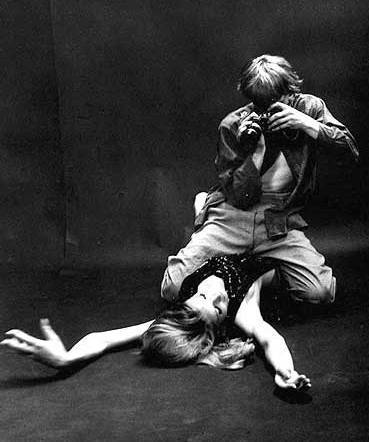
The film is permeated by a sense of sly humour. An early scene captures Thomas doing a photo shoot with real-life fashion model Veruschka, and Antonioni plays out the scene with a strong subtext of sexuality. It is as if the photographer and model are engaging in virtual intercourse; complete with lines like "now give it to me, really give it to me, my love" and a mock-up of post-coital exhaustion. Much of Veruschka's sensuality is coldly calculated. Glossy surfaces housing empty beings - Antonioni's major theme, the connecting-thread in his whole body of work.


Thomas wanders into a park, sees an unlikely couple - a middle-aged woman with an elderly man - and out of both boredom and voyeuristic curiosity starts shooting them. The woman (Vanessa Redgrave) notices, comes to Thomas and demands that he hand over the roll of film to her.


He refuses, promises to send her the photos later. He is followed back to his studio by the woman. She repeats her request, even makes a sexual advance as 'payment', but is interrupted. Interruptions are the film's building blocks. Antonioni's characters don't really have deep-seated motives, a philosophy to live life by. They're empty pages coloured with fancies as they come.

Thomas goes to nightclub where The Yardbirds are playing. Jeff Beck's guitar processor starts malfunctioning; in a fit of rage he breaks his guitar (mimicking the antics of Pete Townshend) and throws the broken fretboard to a rapturous, drugged crowd. There is much pushing and shoving as fans try to get this souvenir. Thomas grabs it, runs outside and throws the fretboard on the pavement. A fellow standing nearby picks it up, examines it (of course, not knowing that it is Jeff Beck's) and throws it down again. Two points to note: 1) Thomas really had no reason to grab and run away and just did it to disappoint the others, and 2) that a thing, once stripped from its context, does not convey any meaning. The first gives us a guide to understand the psyche of Antonioni's characters (Jack Nicholson in The Passenger decides to exchange his identity with a dead, similar looking man without any apparent motivation). The second gives us the thumb-rule to understand his films. There is hardly any sequence in an Antonioni film that would stand on its own merit - you cannot talk of scenes unless you connect it with the others.

The woman (Vanessa Redgrave) who wanted the roll of film back visits Thomas. He hands her a fake and develops the photographs he took in the morning. As he pins the photos side by side and examines them he thinks he has unwittingly caught a man being shot down. To get a clearer look he blows up a part of the image. There's a lot of noise - graininess - so we can't be exactly sure. He seems quite certain though.


The mise-en-scene here deserves special mention. A photo of the woman looking away while she embraces her lover becomes a sort of reaction shot.
But whereas the reaction shot is traditionally used to reinforce the illusion of reality*, Antonioni subverts by not clearly showing the object that draws her attention. The camera pans from the still (shown above) to the wall where a blowup of the fence she seems to be looking at is pinned. (Illustrated in the following screenshots)
The resulting visual joke is that the woman is looking from the confines of her photo to the bush and fence shown in the adjacent photo. But we still can't see what she's been looking at**. The other - larger - subversion here is of a close-up. Originally the close-up was invented because objects could not be fitted completely into the aspect ratio of the frame. Hence a part of the object or person was shown, and the camera was sometimes moved to capture the whole part by part. This largely worked as a synecdoche (i.e. the part representing the whole). But whereas the classical close-up clarified or emphasized intent, Antonioni's close-up says that the deeper we try to go the more the object of our concern disintegrates ("blowing up" in a deliciously ironic sense). It also serves as self-criticism: Antonioni's films being basically probing character studies done in a minimalist manner.


For some inexplicable reason, Antonioni actually shows a gun sticking out of one of the bushes, and later, a corpse lying beside a hedge when Thomas revisists the park in the night. Which seems strange given that Antonioni has been trying to bury the deterministic trait in classical literature and cinema uptil this point. (An alternate reading might be that Thomas really did spot the truth but has no concrete irrefutable evidence to back his discovery.)


Perhaps this is overcome, and explained, by the celebrated finale. A group of anarchic teenagers, dressed as harlequins, show up the film at several points. This group now arrives at a tennis court just outside the park which was the "crime-scene". They mimic a game of tennis. But between themselves the excitement and enthusiasm in this make-believe game is real, as is their match. Thomas looks on, amused. Then the invisible ball gets out of court and the players insist that Thomas throw them the ball. 

Now that he has participated in their make-believe, he can hear the sounds of the tennis ball hitting the ground and the rackets (before this, the match is played out in silence). This is unusual given that the film never uses non-diegetic*** sound except in this scene. All of Herbie Hancock's wonderful jazz score can be heard only when the radio or the record player is on. Antonioni's daring use of sound makes us conscious of the illusory nature of cinema: which resembles and comes to life (the non-diegetic becoming diegetic) only when there is communal participation and suspension of disbelief (in the cinema theatre).


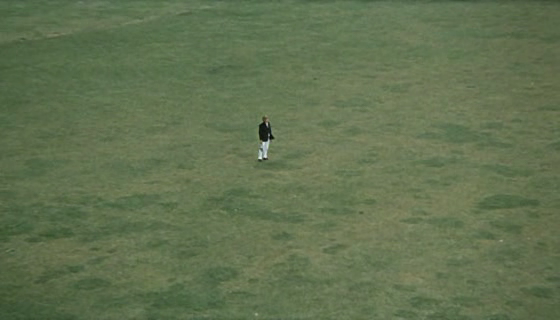
The final sequence of the film shows, in a long shot, Thomas standing in the field. His image slowly fades away. Thomas is unreal - a character in a make-believe medium. The camera lies. Did Thomas' camera lie too? And does Antonioni's camera lie when it shows us the corpse?


Footnotes:
*A typical Hollywood trope is to cut next to a POV - if one shot shows A (in the frame) looking at B (out of the frame), the next shot shows B (now in frame) from A's perspective.

**The viewer who wants to see for himself if there was a murder or not must understand that the photographs are taken from a single point in the park - where Thomas was hiding behind a tree - and that is our reference to determine directions.


***In simple words, diegetic music/sound is one which is being played in the space being exhibited, i.e. the music/sound belongs to the "world" of the film/play. Non-diegetic is when the sound does not belong to the space in focus.

Monday, 20 June 2011

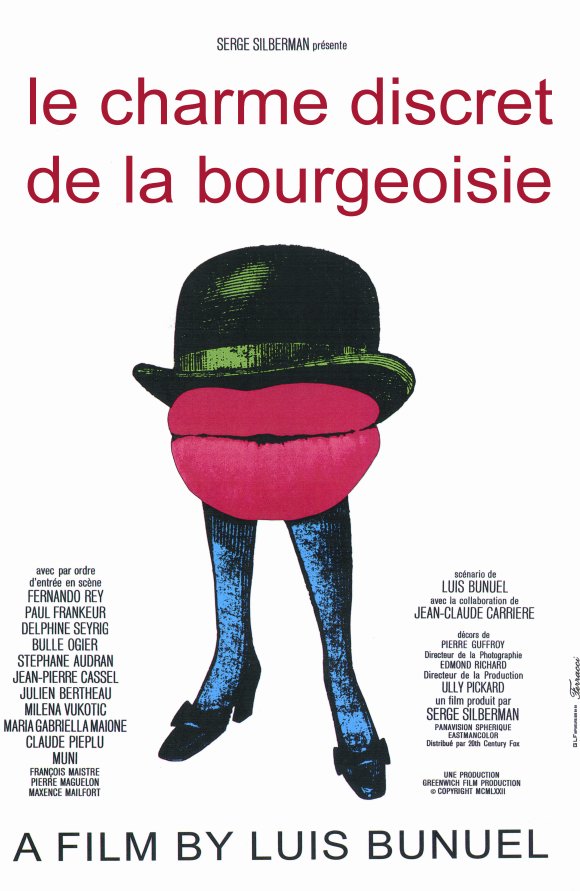
The Discreet Charm of The Narrative


Luis Bunuel's The Discreet Charm of the Bourgeoisie holds the promise of a "proper" (classical) narrative throughout its length but doggedly fails in keeping it. Here is a film that pretends to head for the centre, all the while running off into tangents. It is almost as if Bunuel is trying his best to control his surreal urges and make a conventional, conformist narrative feature; but yields repeatedly to his playful, naughty side.

Gone is the sort of openly rebellious, distinctly surreal imagery that populated his early work (Un Chien Andalou or L'Age D'Or). There is an air of naturalism and realism in the proceedings: hints that this film may follow the cause-and-effect logic of classical narrative. We see one of the characters - a high-ranking diplomat - smuggle cocaine in his luggage. A lady promises a priest that she'll narrate the story of her faith to him. Bunuel throws around these nuggets with exquisite care. He has the diplomat explain in detail how he managed to smuggle the stuff in. But there's no follow-up. It appears the director has lost interest in the sort of conventional film his handiwork is headed towards, so he turns his attention to another little incident, follows the narrative thread for a while, and diverts his attention yet again.

The running gag of the film is that a group of high-class socialites sit down to dinner several times but never actually finish it. Bunuel's own little joke is luring his viewers into believing that Discreet Charm is a conventional narrative. Like his protagonists, we never get finished with the "story" - our dinner. It eludes us before a normative conclusion can be reached.

Discreet Charm is as much a critique of complacent, disengaged entertainment (the sort that Hollywood has always readily served up) as it is a hilarious parody of bourgeois manners (with some typical Bunuel targets thrown in for good measure - bureaucratic, military and religious). At a restaurant, the three ladies of this film ask for all sorts of beverages - tea, coffee, water - but the waiter informs them that none is available. Nothing in Bunuel's film is readymade for easy consumption.

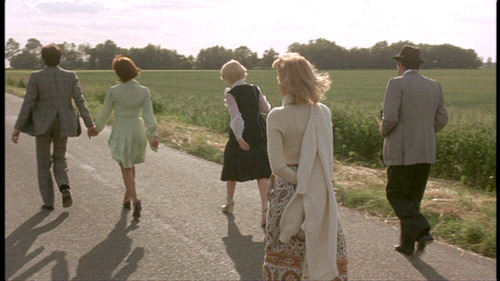
One sequence in the film is shown thrice, being the last as well. It has the motley group of socialites walking endlessly through an empty field. Bunuel's parting statement is cheerfully nihilistic - coming from nowhere, going nowhere. It is a wonder a film so mischievous and rebellious in its opposition to Hollywood's values of filmmaking won an Academy Award for Best Foreign Film.