Showing posts with label Relationships. Show all posts

Monday, 13 December 2010

Beyond the Apu Trilogy: Kanchenjungha

Satyajit Ray crowds the discussion on serious Indian cinema to such an extent that it is almost useless to write again on his films. But then, few filmmakers have had such an impact on me as him. So this post is mainly an exercise in articulating my own reasons for admiring him. Bear me as such. In my defence, I may have a few good bits on what you already know.

From the point-of-view of the Westerner, the Apu trilogy is supposedly Ray’s most significant contribution. While the merits of those three films are undeniable, I see little point in writing about them. I’ll write about some of the others that I consider great and have a personal affinity for.

**
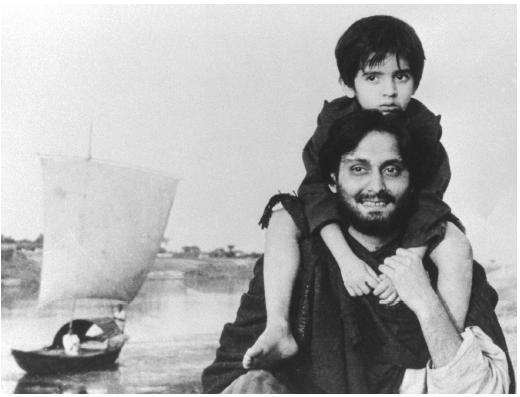
The urchin in Kanchenjungha (1962).

An upper-class Calcutta family has come to the hill-station of Darjeeling to spend a vacation. The narrative encompasses the day before their planned departure. The patriarch is a relic of the Raj: educated, rich businessman with a title (presumably for co-operating with the British rulers, or making a sizeable donation to the coffers) and a vain, insensitive ego. He wants to have his younger daughter – Manisha, who is sensitive, soft-spoken and just 19 – married to a well-to-do engineer with some social status and security. This underlines the significance and urgency of the day. All events in the films ultimately center upon what decision Manisha makes. The suitor is an amiable man possibly in his 30s – Banerjee – a little too formal, somewhat pragmatic though overall likeable.

The patriarch, Indranath Roy, has a sensitive wife in Labanya. She has long turned spontaneity and self-esteem inwards, submissively putting on a façade of agreement with everything her husband says and does. She doesn’t seem to be too happy with the present situation Manisha has been forced into, yet she cannot bring herself to oppose her husband on his stand. Labanya’s brother, Jagadish, is a cheerful, philosophical man who likes to stay alone with his passion – bird-watching. The contrast between Jagadish and his brother-in-law is etched in a wonderful comic scene where he tries to arouse some ornithological interest in Indranath. “Can the bird be roasted?” Indranath asks. For a moment, Jagadish cannot fathom the question. When he says no, Indranath smugly says that the bird does not interest him in that case.

Manisha’s elder sister, Anima, has an unhappy marriage with Shankar. We come to know more things about them as the film progresses, but it is established in the first few minutes that Shankar is cynical about the family’s subservience to Indranath as well as his failed marriage. He also reveals shades of concern that Mani might be emotionally manipulated to accept Banerjee as her husband inspite of her true wishes. Anima and Shankar have a daughter of about eight, which is what anchors their relationship inspite of personal differences. Manisha’s other sibling is Anil, a somewhat stupid and happy-go-lucky fellow who chases pretty girls in Darjeeling’s famed Mall. Anil is incidentally the only character in the film whom Ray does not put under the scanner. He is a prototype for the spoilt rich-brat and has little function other than drawing a few easy laughs.

A key to understanding the film from the POV of a westerner is to recognize the typical Indian social mindset that craves security and social standing above all else. It might be slightly confounding to wonder why no one in the family has ever spoken against Indranath’s tyranny. Disagreement stains the façade of family integrity, which no one wants to jeopardize. The fear of breaking an accepted social structure – where the patriarch decides everything – also permeates their mind. No one enjoys this patriarchal supremacy, except Indranath of course, but everyone buries the frustration deep within. Kanchenjungha is, in a way, a search for someone who will have the courage to break the existing social structure.

As a counterpoint to the society-conscious Choudhury family, Ray introduces Ashok, a young graduate from the lower-middle class who earns a pittance by tutoring students. This profession he seems to have in common with a pushy uncle who forms the distant link between him and the Choudhury family. In Darjeeling accompanying his uncle, who is comically unimaginative in the manner of most middle-class babus, he comes across Indranath. The uncle is an old acquaintance of the Choudhurys and wants Indranath, chairman of five companies, to help his young nephew get a job. That Ashok is something of a rebel is already evident within moments of his arrival on screen. When introduced to the big man, he stands straight hesitantly, not doing the “done thing”: i.e. bowing down and paying obeisance (which is the standard Indian custom). It takes his over-eager uncle’s urging to do that.

The events of the day unfold as all these characters walk about the lonely streets of Darjeeling in pairs or alone, coming across one another by chance, then relapsing back into solitude. Ray employs a cyclical structure: he captures a bit of the conversation between Banerjee and Manisha, then switches over to Indranath and Labanya. Then he suddenly brings in a roaming Ashok face-to-face with Banerjee and Manisha, and so forth. The dialogue is written keeping this cycle in mind, so that when Labanya voices her concern that Manisha may have wishes of her own and may not be ideal for Banerjee, we have already seen hints of the clash between Manisha’s natural whimsical nature and Banerjee’s formal politeness.

The true genius of Kanchenjungha is, I think, how Ray pairs almost every principal character with some other at one point or the other, thereby contrasting and comparing their nature and the relationship they share. Also, nearly every character is given a distinct life of his or her own (they could be people we have met ourselves), which is somewhat unusual considering that the narrative is tightly controlled and organized (though that is not apparent on the surface).

Kanchenjungha was Ray’s first film in colour. That Mani chooses a saffron sari to wear on this ‘important’ day already hints that she doesn’t wholly approve of her father’s choice – saffron being the colour of renunciation in Hinduism. We do not yet know if she will accept Banerjee’s proposal, but she wants to make her resignation clear. Darjeeling’s natural beauty is shrouded in mist, which adds a sense of gloom and confusion, thereby reflecting the mood of the characters. I’m not entirely sure the same effects could be achieved on black-and-white stock.

If the film is a document of an old social structure disintegrating, it also marks the birth of several relationships. It is revealed that Anima has an extra-marital affair that she has sustained from before her marriage (she could not marry her lover against her father’s wishes). Shankar has learnt of this, but typically stomachs the failure with his cynical resignation to fate. He has several vices – gambling and drinking among others – which he inherited from his zamindari heritage, but he shows signs of silent remorse. Husband and wife confront each other, break down and while the final reconciliation is far from cheerful, it shows signs of hope that each will try to become better partners. Their daughter – who in her innocence does not realize the tension between her parents and continually punctuates their tragic confrontation with cheerful cries – convinces them to start anew. Manisha and Ashok have only been introduced, but they find some common ground. This engenders not so much a romantic relationship, not quite a friendship, but curiosity enough to explore each other in future. Mani invites Ashok to her house in Calcutta.

The breaking of patriarchal supremacy happens in three separate blows to Indranath’s ego. The most poignant of these is his own wife’s. Left alone for some time, Labanya gives full voice to her pain and frustration in a melancholic song by Tagore. As her saddened voice echoes off the valley, her brother Jagadish silently walks up to her. When she finishes, he says with a smile that she has not sung like that for years. Labanya, like many Bengali girls, has a sweet voice (which is somewhat true even to this day) but her devotion to family has throttled any caprice she had. Somewhat ironically, this is the only defiance that Indranath does not learn of. Even in rebellion, Labanya has preserved family integrity.

Ashok delivers the most surprising of these blows. Though romantic and idealistic by nature, he also craves some of the security that his middle-class peers so desperately want. Forced by his uncle, he reluctantly tails Indranath in some hope of getting the promise of a job. He swallows the businessman’s condescension and patronizing attitude for some time, but ultimately summons enough courage to laugh at his face when he is handed a concrete offer. Of course he’ll have to slog off for some years more, but he much prefers to be self-made than be someone’s fool forever. Indranath cannot understand how someone with low social status can so easily defy him: the look of confusion on his face rivals Jagadish’s astonishment during the early bird-roasting episode.

Manisha’s refusal to cave in to familial pressure probably pains Indranath the most, because he never imagined his daughter having will of her own. It is commendable of Ray that the development of Mani’s character does not seem abrupt. She does not so much reject Banerjee as just keep him waiting. On his part, Banerjee reveals depths as the narrative progresses. While seemingly shallow at first, we gradually see that he is basically a honest and decent fellow. In one of my favourite exchanges, he gives Mani a rare flower she had been looking for. When she asks if he sought it out, he pretends for a moment to have made a painstaking search. Then he feels compelled to admit being helped by a botanist in his hotel. His final words are equally touching. “Maybe these romantic surroundings make you think that love is the most important thing in the world. But once you're back in Calcutta if you ever feel that security is better than love, or that love can grow out of security then let me know.” Banerjee is part of the traditional social structure, but he shows the best traits of it.

Ray ties the film together with a little native urchin who pesters passers-by for alms. The song accompanying the opening title credits is a folk tune sung by this boy. When Banerjee and Mani begin their walk, the boy tails them for a while before giving up. Banerjee had placed a bet with Mani that he would give her a chocolate bar if they did not get to see Kanchenjungha before leaving for the city. After Mani refuses his proposal, he makes his way back alone. The urchin tails him again. Banerjee had forgotten about the chocolate bar in all the confusion. He smilingly gives it to the boy. Magically, not long after, the mists clear and Kanchenjungha is seen. Ironically Indranath, who was most keen about the range, does not have the mood to enjoy the vista anymore. The film ends with the urchin singing the same song that played at the start, this time smiling as he relishes the bar of chocolate.

In its own way, Kanchenjungha also comments on the relationship between nature and man. Ashok says he had the courage to refuse the job only because he is in Darjeeling. In Calcutta, he most probably would have accepted the offer. Nature gives him the inspiration to be true to his conscience, just as it probably guided Mani in her defiance. Jagadish, of course, is the classic example of a man happy in his co-existence with nature. Indranath, with his superficial touristy enthusiasm about the Kanchenjungha peak, is the only disappointed person at the end.

Cast:
Chhabi Biswas: Indranath Choudhury
Karuna Banerjee: Labanya, wife
Anil Chatterjee: Anil, son
Alaknanda Roy: Monisha, unmarried daughter
Anubha Gupta: Anima, elder daughter
Arun Mukherjee: Ashoke, young man from Calcutta
Subrata Sen: Shankar, Anima's husband
Sibani Singh: Tuklu, Shankar and Anima's daughter
Vidya Sinha: Anil's girlfriend
Pahari Sanyal: Jagadish, Labanya's brother
N. Viswanathan: Mr. Banerjee, Manisha's suitor
Guinye: street urchin

Wednesday, 3 June 2009

Turtles Can Fly

To wholly understand this film, we must assess what we mean by children's cinema. Where can the possibilities that can be explored by the genre be limited? Further, is it cinema meant for children, or cinema made by children? The clues to these we shall find as the journey wears on. Till then, keep your head clean.

Bahman Ghobadi lends the film its colours from, among many things, a variety of well-drawn characters. There is Satellite - so called for his fame throughout the Turkey-Iraq border, where the film is set, as a proponent and installation-expert of dish-television. But Satellite has a more important role as well: he is able organiser of boys in the refugee camps. He divides, supervises and directs the large group, which includes several handicapped boys, to nearby fields for combing landmines. These are sold off for money - much needed and equally missed, if not more, in the war-ravaged country. There is a disconcerting ease and dexterity about this affair - the little boys hesitate little while toying with death or, worse, crippling injury. The whole unthinking simplicity of it, almost petty errand-like, takes us close to the human tragedy of war-torn people. If one must embrace fatal peril to live a day more, so will he! This queer coexistence of life and decay is also quietly evident in the village landscape, where many of the homes are abandoned battered battle-tanks and missile launchers. Satellite is not immune from the snobbery of being a leader, neither can he help being smitten by Agrin. This young girl has a beautiful face, unassuming and quiet; the pall of gloom and pain only helps accentuate her personality. Agrin is remarkable in her silence, her intense eyes are ever on the look for some saving grace: a purpose to justify her existence. Silence shields away her torrid past - she was raped in early childhood and her family was eaten up by war - the first fact no one but her brother Henkov and herself is aware of. She is burdened with a relic of that sad incident, a physical reminder of what she wants to forget: a little child Riga. Riga is blind - possibly God's wish to keep him oblivious of and untainted by the ugliness of this world. As he gleefully rends the skies with his bubbling peals of laughter and innocent weeping, there is no way that one can stop the tears rolling down. Riga speaks to humanity's conscience, consistently posing our minds the crucial and difficult question - why some people must go through such terrible oppression and injustice - and at the same time appealing to our heart through his ironic innocence. His father is some cruel beast unknown to him, one whom even his mother does not possibly remember! Yet how different the river is from the source. When Riga goes plaintively crying out to his parents amidst war-debris, silence answers him back. For he is a child of severed circumstances. Silence is Henkov's shield too: behind it he holds a pained empathetic heart, at times brimming with rage, but unfailingly humane. Even optimistic - which is a difficult quality in someone whose consciousness has been marred at every stage by terrifying incidents. He wants to live, whereas Agrin wants to escape into the soothing skies. She cannot make peace with her circumstances anyhow. Henkov's concern and love for little Riga is deepened by his sister's neglect of him. While Agrin is always spurred to abandon the child, her brother wants to draw him closer and safer.

Satellite, inspite of his seeming arrogance, has a soft heart. His concern during a bomb-scare is not only for his own associates but every refugee boy in the area. His attempts to win over Agrin are earnest and innocent. Acting as counter-foil to the illustrious Satellite is his second-in-command Pashow and faithful disciple Shirkooh. The latter is mostly introduced for comic relief: ever-inquisitive about the meaning of "USA", "Come on!", "Hello mister" and suchlike; getting bullied by elderly Esmaeel and relating the grave injustice meted out to him with a rare touch of both humour and compassion (you smile at first as Shirkooh rattles off teary-eyed, then realising his innocence you suddenly feel like comforting him with love). Pashow is ever-ready to follow in his leader's steps. The sight of him, disabled leg dangling carelessly, running behind Satellite in swift strides with the aid of his crutch is one to behold. Ironically, the leader has to follow in his second-in-command's steps later as he falls victim to a landmine.

There is a scene where Riga is abandoned by Agrin just beside the barbed-wires between Iraq and Turkey in the hope that the Turkish guard on the other side will shoot him. As the little one wrenches hearts with his tears, Satellite and Pashow are passing by. Driven both by curiosity and compassion, the two come to Riga's rescue. To make him smile and 'chide' the guard, Pashow grabs hold of his defunct leg and points it like a gun towards the Turkish guard with mock-menace. It is a fine example of the director's ability to reach into the most cornered recesses of the human mind - the image conjured up is brutal and shocking in a playful non-chalant way.

In another sequence, Riga finds himself alone in a mine-plugged field. A step in any direction could spell danger. When Satellite hears of the incident, he reaches the spot. Riga's position is precarious, yet blindness blocks off any awareness of his surroundings. As he stands there scanning the air about with his senses, Satellite must find a way to save him. This emboldens the humane side of him already revealed before: his concern for others is unaffected by any factor save the immediate need for it. The crisis also adds an unknown dimension to two fringe characters - so troubled are Pashow and Shirkooh about Satellite's safety that they are ready to take the risky plunge themselves. Their leader however vetoes any such intervention. The repeated tinkling of a bicycle-bell ensures that little Riga is delighted, while also drawing his attention to the repeated warnings not to move from his spot. Ears strained to follow instructions, Riga ponders for a while before bursting into renewed peals of merry laughter and jumping here and there egged on by the sonorous cry of the bell. And just as Satellite crawls to touching distance of the child, a mine goes off. A scene with palpable taut tension, yet one that evokes the deepest of empathy for both Riga and Satellite, while offering a glimpse into the hearts of as many as three characters; culminating into an emotional upsurge. Once again, Ghobadi displays his fine understanding of human psyche - Riga's joyous laughter in such a grave situation can only be called a cathartic experience for the viewer. The director defeats expectation when the mine explodes, and yet does not come off as one merely looking to disappoint or shock his audience.

The skies accept Agrin's prayers however. She flies into them from a cliff, burying her troubles in a war-torn land. Strife swallows up Riga too - not so much one fought with guns, as one between Agrin's troubled heart and conscience. The only one left of the family is the compassionate, quiet and brave Henkov. His clairvoyance comes a little too late for help. The only memoir of the past Agrin leaves behind are her slippers, a souvenir the pained Henkov keeps with him.

It is fitting that a bitter condemnation of war should end with a dark realisation. Throughout the film, Satellite is in awe of the American legend. A concoction of iconic images and catchphrases - Titanic, Washington, San Francisco, Bruce Lee and Zinedine Zidane (an aberration Pashow rectifies) - is part of that hallowed glossy dream (the distance - psychological and geographical - helps no doubt). Besides, America is noble: they'll rid Iraq of Saddam's terror-reign. And yet, as the depressing deaths of his sweetheart Agrin and endearing Riga touch him, the legend corrodes gradually. So when, in the final scene, a relieved and excited Pashow exclaims "Look! Didn't you want to see the Americans?" as US troops file by, Satellite turns his back on them. His silence - that most potent weapon Ghobadi uses throughout the movie - reveals his deepening doubts if there really is a good side to this war; if really anybody's victory calls for celebration. (A note: I am aware some critics perceive Ghobadi's leanings to be pro-US. However, that is not evident in the film. Kurds are initially portrayed wishing for US intervention, but through the protagonists - Satellite and Henkov - the denunciation is of war itself, without colour and without side.)

And yet for such a bleak subject, the treatment is not all brooding and ominous. There is humour centering around the Islamic dogma of chastity in thought - the village governer visibly shakes as he encounters a "sexy channel" on TV. There is, of course, amusement in the dialogues between Satellite and Shirkooh and Esmaeel. There's a hint of dark comedy too: as a gift to his dear injured boss, Shirkooh brings along the broken hand of Saddam's gigantic statue (the demolition of which has now become an iconic spectacle). The director's palette comprises of poetically composed shots - the distribution of colour across the screen is remarkably refreshing (of the same school as Majid Majidi's work). The camera does not rely on daring tricks, and yet makes efficient use of props in the locale. One memorable illustration has Satellite perched on the very head of a cannon whose shaft can be moved about, and the scene ends as he is slowly lowered down with just Satellite's ever-present baseball-cap ducking out of sight at the last moment.

Now, to think of my questions at the very start of the essay. For one thing, I am certain that none of the kids who caught the show with me at Nandan completely understood what they witnessed though they may have laughed at the jokes, felt at one with the joyous laughter of Riga and sympathised with the plight of the affected. Which is quite a lot: the audience just connecting at an emotional level, even if not comprehensively analysing cinematic theme and technique, is something any great director would wish for... in fact, wishes for! Analysis is only for academics, enthusiasts and the like. It is also noteworthy that the simplicity and purity of emotions portrayed could only have rested in a child's bosom. This is children's cinema. Relegating the genre to fluff like Hanuman Returns (sorry Anurag Kashyap, I love almost every other film you've directed!) is underestimating a child's inherent emotional and intellectual faculties. That's a mistake every sensible filmmaker - and broadly every sensible adult - should avoid.

To end with, one of the very best films I've seen. (It, along with Majidi's films and Mohsen Makhmalbaf's Kandahar, has awakened me to the Iranian New Wave - thanks in no small measure, Mr. Ghobadi.) Oh, and Hossein Alizadeh's background score is gorgeous. Not merely an embellishment, rather an essential part of the film's being.

Friday, 20 June 2008

A Tale of the Lost

It all happened quite a long time ago. They were the residents of Gosainpara, Mukundapur. Her father, with a rotund belly and huge moustache (a typical iconic example representing the middle class male-dominated-society) worked in a small grocery store that stood at the end of the lane. Her mother, a homemaker, was the mistress of the kitchen, a kind and a meek personality adorned by the red-bordered white sari worn in the old Bengali style and a big round red Sun of the sindoor drawn on her forehead. The family scene can be completed by the presence of children (and sure enough, there was no dearth of it in her family): they were three sisters (including her) and a younger brother, she being the eldest of all.

She studied in the ninth standard then, in the neighbourhood Malati Girl’s High School. She remembers the small classroom, the small desks and chairs made out of rusted tin – she, solving Maths sums, sitting at her desk at her corner of the room… Two plaits done with red ribbons hung low on her shoulders, the blue blouse and the blue-bordered white sari neatly ironed and pleated – she remembers it was the year she had just started wearing saris… It was then that she met him, her Benimadhab.

The first time that she met him was at the house of her close pal Sulekha. He had just returned to the town from the city, completing his higher education. They used to say that he was a good student – yes, he must have been a very good student… She was just a mediocre student, she recalls, “poor at Arithmetic, but good at literature”. Oh, yes Benimadhab! She had completed the Sharat Rachanabali by then (from the neighbourhood library), but Bibhutibhushan was still her favourite…

Benimadhab came from the city, but heaven knows why that made her realise she wasn’t pretty! She was dark and thin. She also realised that her father was a mere grocery seller – “Would you mind that, Benimadhab??”… Ah, Benimadhab, nothing would stop the hues from blossoming in the spring! No, it did not. Everytime you looked at her, she ran to hide herself, her heart beating, her apprehension giving way to ecstasy… After all, it was her class nine; it was her “sweet sixteen”!

Did you know anything of her feelings, Benimadhab?? She was so sure that you understood her, that you read through her “unwritten saga”, that you also had fallen in love with her… She never uttered a word about it, never a word, never to anyone.

Do you still remember her, Benimadhab?? Ah, yes! You must have said all about those days to your girlfriend, your sweetheart… She saw her only once, beside you, beneath the moonlight – flash of a brighter light, a harder light of truth! Her eyes burned, her throat choked. She didn’t cry... That day, she took the other way to home.

She never said a word – never to anyone. Her tale remains untold, buried deep in a forgotten ally of her heart. The following year, her father died of a stroke. Her mother, a widow now, didn’t have the sun of sindoor anymore adorned on her pretty forehead – a life that was to be led san colour, san taste, san merriment for the rest of it’s time. She was the eldest of all her siblings – “Bordi”. After passing her Madhyamik exams, she started tutoring the girls of the locality the art of sewing: something at which she was very deft and for which nobody seemed to ask her a degree or a certificate. The income was really meager at first and for the first few years, the family of five was almost under starvation. She was insistent on the education of her younger sisters and brother, but the school fees remained unpaid for quite some time… Their mother passed away four years following their father’s decease.

She stirs back to the present, twenty years since she was sixteen – twenty years since “Benimadhab” happened… The sister after her has taken into the profession of a call girl. This sister doesn’t live with them anymore, neither does her brother. Her brother works as a motor mechanic in the city and now resides there. She has remained unmarried – the battle for existence has been so hard that she has never had a chance to brood over her “emptiness” – the strands of harsh reality have stifled down the sobs of a teenaged girl.

I’ve retold Joy Goswami’s poem in my own words, in my very own way (I hope readers will pardon my impudence). The story could have ended where her silent romance with Benimadhab was unintentionally betrayed. But, it didn’t. Probably, because that was simply the beginning of her tale – the journey that had to be hers and hers alone. The craving for a friend, for someone to love, for someone who would stay and walk the life with her, for someone who would be there to give her the littlest of the warmth and support that every person desires – all of it started there. Precisely, “Benimadhab” was the commencement of a barren life, won over with extraordinary blatancy.
“Benimadhab, benimadhab, tomaar baari jaabo,
Benimadhab, tumi ki aar aamaar kotha bhaabo…”

At the end of the poem, a suppressed pain upsurges after all these years and suddenly, she wonders if the chastity of her faminity that she has preserved through all this time was enough a “sacrifice for nothing”; if that would ever be acknowledged by the world at large. She amuses at the stark cruelty of her fate and tests the world with a final question, “Kemon hobe aamio jodi noshto meye hoi?...” [“How would it be if I also took to prostitution?...”]

Epilogue:-

Hers isn’t a Cinderella story and she hasn’t been a Cinderella. Hers is a tale of an utterly ordinary woman (once a girl full of sensuality and perhaps, "possibility") – the Bangla tutor of the local primary school of a small town, the sewing mistress of the locality, the sales-woman at the mini-store, the type-machinist at the Xerox shop… She talks little; she is not pretty neither is she an intellectual; with a serious face but kind features, she is a person we all have met somewhere… Hers is a story of the lost – hers is a story which isn’t found in any of the world epics. Hers is a tale which is to be written yet…

Monday, 2 June 2008

Floating Lamp of Shadow Valley

"If there's paradise on Earth, it is this, it is this."


Kashmir. The closest thing to heaven on Earth. A valley sparkling in serene beauty-- snow capped mountains, moss-covered lakes, trees adorned in brilliant green, boathouses, and a little boy named Arif.


This is the story of a boat-"man". Of Arif. A nine-year old child who has the wondrous eyes to look at his world; who, at this tender age, knows what is duty and what is whim, what is right
and what is wrong. This is the story of Arif. And of a reason why I still want to live.


The sole earning member of a family of six, Arif gets up every morning and goes out with his boat for a day's work. He has to work every day; for if he doesn't, the whole family will have to go without food. With such a firm responsibility placed on his tender shoulders, Arif has accepted his fate with cheerful happiness. That is why the cold winter days cannot subdue his spirit-- he still manages to push his boat through the frozen Dal lake with firm determination. His thin arms have already developed the strength to push the oar through such a difficult terrain, which is no different from Arif's own life. And Arif knows that his arms have to push the oar forward so that he can reach the other bank-- for that is where his dreams lie.


Arif lives in a small shack built on the edge of the water with his mother and four other siblings:
two little brothers, an elder sister and a little one too! His father is a terrorist, who does not take care of the family but wastes his time swaying between gun and dope. Hence, Arif has been left with no other choice. On a good day, he gets about 50 rupees from ferrying passengers to and fro. And he hands all of the money to his mother, who is slowly saving up so that one day they can buy some land of their own and build a house.


When asked about his father, Arif says that he does not care for him. Arif knows that what his father is doing is not right, and he does not mince his words when expressing so. Even at the early age of nine, Arif has already learnt one of the greatest, and yet undeniably important lessons in life-- killing people is unpardonable and wrong. He could easily have chosen the gun to eradicate his misery. He picked up the oar at the age of seven instead. Rightly has Dumbledore said that it is choices that ultimately decide who we are.


The little boy has witnessed the burning face of terror himself-- once when he was in Srinagar, the tourist department was blown up by terrorists before Arif's own eyes. That was the day before the now (in)famous Srinagar-Muzaffarabad bus started as a conciliatory gesture between India and Pakistan. The boy expresses how suddenly fear struck him that day-- fear not for his safety-- fear from apprehension and a terrible gut-feeling: what if one of the terrorists involved is his own father!


Arif's shack has got new holes in the tiled roof. So he sets off for the big city once more with his younger brother to buy a new sheet of plastic to stretch on the roof of hishouse. This time, he takes a different route than the previous time. What if terrorists attack again? Well, terrorists may attack anywhere, but then Arif will have to find another route then! At least, that is what the innocent child thinks.


The house is mended. But the Dal Lake belongs to none, and most certainly not Arif and his family. The authorities have notified Arif's mother that if they do not evacuate within a time bracket, the shack will be torn down. Arif has no answer this time. He does not know where he will go if his house is demolished. But he knows one thing-- that there is only one gateway to a bright future: education. And hence, Arif takes himself and his siblings school by himself on his dear old boat (which has gone through a repair already so that it does not fall apart from being worn down by water and weather). The image of a nine-year old child in school uniform rowing four other children in his own boat is heartening-- the boy is already performing a duty that elders do. A young boy shouldering the responsibility of grown-ups is something that is rare in our 'normal' world. Perhaps, only desperate times and situations rear mature men! Oh, how happy would I have been to see people my age become only half as mature and responsible as Arif!


And yet for all his maturity, Arif is a child. A child at heart, not one merely by age. It's raining hard, and Arif has a huge lotus leaf perched on his head to protect him from the downpour. And suddenly he notices a small pup playfully balancing itself in a small "island" of floating debris in the lake. A boy who has no friends because he has suddenly grown up so much has a new companion now. He takes the pup home with him, lovingly caressing it's fur in between bursts of rowing. The children rejoice in the arrival of a new friend back at home. But happiness abandons the family again. The little dog is run over by a car. And it is absolutely heartbreaking to see tears rolling down the cheeks of all the small children as they give their lamp of shortlived mirth a proper Muslim farewell.


It's good bye time for us too. Who knows what happens to Arif? No one. And yet, as a viewer, I am optimistic. Perhaps he is still ferrying passengers. Perhaps his family have finally succeeded in affording a plot of land of their own. But we do know one thing. We know that there is something to learn from this story. A few things from that little child. The school-shooting champions (if you know what I mean!) could learn a bit of right and wrong. The spoilt and pampered brat could learn a bit of responsibility. And, maybe, everyone of us could learn a whole lot of unaffected innocence.

Saturday, 9 February 2008

E.T. - The Extra Terrestial


If I had to name one of those movies that I shall remember fondly all throughout my life, E.T. is a must on that list. Not because it's sweet: many films are just sweet. E.T. is much more than that-- it touches my heart everytime I watch it. Even yesterday, as I watched the film for the umpteenth time in two years, I felt tears swelling up in my eyes. But I don't rate the film so highly just for it's very emotional content: I am an ardent fan of it because the film so beautifully shows us that even the weakest of beings on earth, in fact the universe, have a huge power in them. A power that beats the darkest of thoughts: love! Simple as it may sound, I feel that no other emotion is as brutally tortured and profaned (as Shelley said) as love. But I won't go into how most of us have profaned the greatest of all emotions: there'll be a separate post for that coming up in a few days (since Valentine's day is just round the corner). And since the film is such an old one, I don't have any qualms in revealing spoilers. I shall talk about the film in detail, and hopefully in it's whole entirety.

The film begins with a group of alien botanists collecting bio-samples in a California forests. As US government agents arrive at the scene, the aliens hastily flee in their spaceship leaving one of their kind behind. Meanwhile, in a California suburb, a young boy named Elliott has to cater to the orders of his elder brother, Michael, who is having a round of games with his pals. As Elliott rushes out to fetch pizza, he notices a strange creature by the house. While Elliott is himself quite frightened to see the alien, the alien is also initially quite terrified to the boy, most probably because he (and his kind) has already been chased by humans (US government agents). Elliott's family doesn't believe when Elliott tells them how he had spotted something strange roaming around the house. Just to prove his suspicions right, he lures the alien into his house by leaving candies in the forest leading into his bedroom.

Elliott discovers that inspite of his initial fears, the alien is a friendly being. To amuse the young boy, E.T. imitates the movements of Elliott. The two strike a sudden kinship, and a very tired Elliott finally doses off to sleep on his sofa. Next day, to avoid school, Elliott feigns illness, and spends the day playing with his new friend. That day, Elliott also introduces E.T. to his elder brother, Mike, and very young (and very cute!) sister Gertie. The three siblings ask E.T. about his home, showing him their own location on the map and the globe. E.T. levitates some balls to show that he is from outer space and points to the representation of the solar system in the encyclopedia. E.T. also heals a withering plant to show his powers of healing the dying.

Elliott and E.T. now share a psychic link, which becomes apparent because Elliott begins referring to himself as "we". Because E.T. drinks quite an amount of beer, the psychic link to Elliott makes the boy feel extremely drowsy at the dissection class. Under a sudden impulse, Elliott decides to free the frog to be dissected by him-- an example soon followed by his classmates. As E.T. watches two lovers kiss each other on T.V., the psychic link works again-- this time leading Elliott to kiss his crush at school!


Meanwhile, E.T. learns to speak by watching Sesame Street on T.V., which amuses the little girl Gertie very much. She tries to tell mum several times that her friend E.T. has learnt to speak (though, mum is totally unaware even of the existence of E.T. in the house!), but mum is so busy that she can't even stop for a moment to listen to her daughter. A very fitting and notable portrayal of usual parental attitude towards children: that of negligence. Elliott and Michael arrive at home to see E.T. not present in Elliott's room, much to their worry. And then they discover their friend in the toy-store of their little sister. Gertie cheerfully tells them that she taught E.T. how to speak, and just to celebrate that occasion she has dressed E.T. in a brilliant women's attire (again, much to the dismay of the two brothers). Both Elliott and Mike are happy to see that E.T. has learnt to speak like humans: and they hope to have some free conversations with their friend. But E.T. only keeps on muttering 'E.T. phone home', by which Elliott understands (as a loner himself) that E.T. is feeling terribly homeseick by now and wants to go back to his own home. And so he and his elder brother decide to devise a 'phone' to contact E.T.'s own kind. They chance upon some trash in the garage, in the process also discovering an abandoned shirt left behind by their father, who recently has had a messy divorce with their mother. The shirt re-awakens some lost happy memories of early childhood in both Elliott and Mike. Elliott has his hand cut by a sharp-edged gearwheel, but E.T. heals that in an instant with the miraculous power of his glowing finger (while Elliott looks on disbelievingly).


On Halloween, Mike and Elliott dress E.T. up as a ghost, and lie to their mother that the ghost is actually Gertie (who separately leaves for the halloween party). With their crude model of the 'phone', Elliott leaves for the forest with E.T. on his bike, with the promise that he shall return home before the evening ends. Meanwhile, on the way to the forest E.T. uses his powers of telekinesis of make Elliott's cycle fly-- a stunt that the boy is initially afraid of (due to his fear of heights), but later ecstatically enjoys. The brilliant and historic scene of Elliott's cycle against the backdrop of the huge white moon remains on of my most favourite cinematic moments. But the call to E.T.'s home takes a lot of time, and Elliott can't help but break the promise he had given to his brother about returning home in time. Meanwhile at home, mum is worried about Elliott's absence, and she calls in the police for help. Mum thinks that Elliott must've fled due to the emotional turmoil he has undergone due to the recently concluded divorce. Elliott sleeps in the forest through the night, and wakes to find his dearest friend missing. He returns home a sad boy, much to the relief of mum. Mike meanwhile goes to the jungle in search of E.T., followed slyly by a government agent, and finds the alien in a very ill state. Back home, with both Elliott and E.T. very ill, the siblings decide that it's time to reveal the truth about E.T.'s identity to mum. Her reaction is that of panic-- she thinks that the presence of an alien is nothing but a danger to her children, inspite of their assurances that the creature is a friendly and harmless one (I vividly remember how E.T. smiled at mum, inspite of it's visibly impoverished state!).

But as she is about to flee with her children, government agents surround the house and enquire about E.T. A huge contingent of scientists arrive, with their frighteningly developed machinery; and they quarantine both Elliott and E.T. Elliott cries in vain for the scientists to leave him and his friend alone, but in vain. Elliott feels the psychic link between him and E.T. suddenly disappear as E.T. collapses into a condition of near-death. It further pains the boy when his friend is subjected to almost inhuman medication and treatment. But just as the scientists give up on E.T. declaring him dead, Elliott notices a withered flower suddenly regain its life. He visits E.T.'s 'coffin', only to find in surprise that E.T. has been able to establish contact with his own kind, and that he has miraculously healed. When E.T. is put in a van to be taken as a (dead) specimen of living beings from outer-space by the government- authorised scientists, Elliott and his brother Mike devise a plot to take E.T. to the waiting spaceship in the forest by 'hijacking' the very van the scientists use! Mike signals his friends to wait for them at the park with two extra bikes. What follows is a game of cat-and-mouse chase-- Elliott and his friends on bikes competing with the agents in cars. And just as the boys near a capture, E.T.'s telekinesis saves thair day! They all fly to the forest on their bikes to find E.T.'s spaceship waiting for them. Meanwhile, mum also arrives with Gertie and a sympathetic agent, Keys, on the spot. E.T. bids a very emotional farewell to every one of the family, and especially to Elliott, saying 'I'll be right here' with his glowing finger pointing to the heart... A rather poignant, very emotional and brilliant cinematic moment: again, one of my eternal favourites. A subtle statement that all one needs to follow throughout his/her life is the heart: the epicentre of all emotions, thoughts and ideas. Above everything, a fitting tribute to universal love. And with that, E.T. leaves his dearest friends behind, which other than Elliott and his family, also includes the thoughtful and emotional viewer (like me)!

But still, you don't leave the cinematic journey with a heavy heart: at least, I never do. After all, there is so much to and be happy about in this superb film: firstly, that without love, life is nothing but a dull and dreary drag-on. Secondly, the film so brilliantly and simply shows the Christian concept of a messiah from another world arriving and pumping in a whole lot of happiness and love in our troubled lives. In fact, a lot of film critics still do equate E.T.'s character with Jesus Christ. Thirdly, the film also subtly (albeit minimally) shows what is wrong with parenting today: most parents don't even care to listen to what their children have to say, even if they mostly speak very childish and simple things.

I think it would be apt here to mention that some of my classmates have opined that the film is extremely childish, and rather boring. I can't figure out why: have the children in them already died? And have their imaginative capabilities gone so dry that they have trouble accepting the basic fact that a alien can exist in reality? As far as I know, even the greatest of scientists won't dare to oppose the theory that aliens do exist in some part of the universe we are yet unaware of. In fact, a lot of them would stress that rather strongly! Or should I take it this way: that every non-masala or non-action film is a waste of time for them? I am also quite unsure of the fact if they would have been appreciative of the movie had the alien been replaced by some human? In any case, it doesn't take away the fact that I like the movie, and so do the greatest of movie critics in the world.

P.S.-- I am aware of the fact that Satyajit Ray had penned a script called The Alien to be made into a Hollywood film: a project that finally never saw the light of the day. But that doesn't reduce the value of this Spielberg classic-- even if I assume that Spielberg had a copy of Ray's script to his aid, if it were not for his brilliant direction, this movie would not have been the classic it is.

And yes, I didn't like the Bollywood version of this film-- Koi Mil Gaya, simply because it had too many unnecessary scenes and sequences. The only positive factor I found in KMG was Hrithik Roshan's commendable act as a mentally-retarded boy. That's all for now!

Wednesday, 9 January 2008

Taare Zameen Par - A Child's Review


There are films that make you laugh, and there are films that make you cry terribly. Having grown up in India, a country reputed for a film industry churning out either mindless laughathons or melodramatic sob-stories, it's difficult to get to watch the genuinely funny, or genuinely emotional film. And Aamir Khan gifts us both! Taare Zameen Par gives one lots of reasons to both laugh out loud and feel extremely sad. It's a story that relates to everyone of us in the world who have biologically grown up and yet never cease to look at the world through the eyes of innocent children: we can all see the Ishan Awasthi in ourselves, and with more or less intensity, we have all felt the same emotions cross our mind. And that is where TZP succeeds: it brilliantly connects with the viewers. While the antics of Ishan are sure to draw many a laugh (not through spurious rib-tickling humour, but the eccentricity which defines a fantastic childhood), his sobs are also quite certain to melt the hearts of those who have even a tiny morsel of love left in themselves.

To put the theme quite simply: this is the story of a dreamy boy. A boy who had the courage (and I don't say 'courage' because I don't find a better word) to look at the world through different eyes. Someone who could spend his day staring at a puddle of mud stuck in the craters of a road, or the birds flying high in the sky. Or even the little unknown fishes swimming in the drain by the road. This is a story of how the boy, inspite of his markedly different attitude towards life, still managed to attract criticism and wrath for being different. This is a tribute to the Apu-s blossoming in the jungle of bricks and amongst the 'racehorses' running life's 'race' in the cities of India (even if you think the parallel to Pather Panchali is too much, kindly wait till I end this post!). This is the story of Ishan Awasthi.

[Warning: I am revealing a lot of details about the film. So, forgive me for the spoilers!]
The story starts with all the teachers reading out the marks that the students have got in class tests held in Class III, St Xavier's School, Mumbai. And each time Ishan Awasthi manages to score the least of the lot! But no, Ishan isn't worried even a bit about his marks. The day at the school ends, and Ishan is by the drain outside his school, catching little fish using a homemade net, and putting them inside his water bottle! Ishan reaches home, discovers his favourite couple of dogs in his garden and without a bit of hesitation feeds them his test-papers! And that's just a little fun that Ishan has all throughout the day. And so he carefully pours out the fishes from his waterbottle into his personal collection of guppies, and then deliberately annoys his mother. Ishan's life is in complete contrast with that of his brother Yohan, the class-topper, avid sportsman and in short, Mr. perfect-son. But inspite of their differences, Yohan has a soft corner for his brother, whom he dearly loves. The only member of the family not happy with his less-than-genius freaky boy is Ishan's father-- who can't bear to think that while his elder son is everybody's favourite, his younger son is at the end of everybody's complaint: from teachers to neighbourhood parents. And while everyone in house is running about preparing for another day of hardwork, Ishan sleeps peacefully and blissfully in his room amidst an assortment of colours, paintings and toys.

Inspite of Ishan's mother's best efforts, she can't help her son with his studies because he easily forgets everything he learnt the previous day. Ishan can't follow his teacher's orders of opening page no. such-and-such and chapter no. such-and-such, which annoys her-- she thinks that the boy is deliberately pretending not to be able to follow her simple instructions. Worser still, Ishan can't read a word out of his English book! He's ordered out of the class, but given the 'bindaas' boy Ishan is, he takes the opportunity to indulge in his childish pranks. (Needless to say, punishments never perturb Ishan: he has grown both used to and rather fond of them!)

On the day his test-papers are distributed, Ishan cuts his classes-- roaming around in the streets of Mumbai by himself; staring at the pigeons flying, the ice-candyman spraying brilliant colours on balls of crushed ice, and even the most ordinary and common man making his way through the street. That night he cajoles his brother Yohan to write a false absence note for him. But Ishan's misdeeds are discovered by his parents, and when they visit school, they find a barrage of complaints against Ishan waiting for them. And hence Ishan's father decides that he'll have his son sent to a boarding school, in which one of his friends is a trustee. Ishan, of course, is quite angry with his father (brilliant expression of anger from Darsheel, by the way!), but nothing can dissuade his father now.

And hence inspite of all his wishes, the little boy is sent to a boarding school. Ishan can't bear the pain of separating from his family, and especially his mother (the person he loves most). The scene where the family leaves Ishan behind is brilliant and full-to-the-brim with emotion: the viewer can feel, almost tangibly, the pain wrenching Ishan's heart. The song 'Maa' brilliantly brings out the emotions that swirl around in Ishan's heart-- and kudos to Prasoon Joshi, the lyricist, for immortalising the feelings of a child towards his mother (I think Shankar Mahadevan also deserves special mention for his excellent and soulful vocal performance on the track).

It's too much for a little child to resist the heart-break of staying away from the family, and when that is compounded with a feeling of desperation and extreme loneliness, Ishan starts feeling that his mother deliberately left him back. He cries every night in the hostel bathroom, but no one can help him. Ishan's reception at his new school is the same as his old one. He still can't follow lectures, obey instructions, or for that matter, even read out a few lines from his reader! During the hindi class, the teacher orders Ishan to sit beside the topper of the class Rajan so that the company of a 'good boy' may help Ishan with his studies. That, quite incidentally, is a blessing in disguise-- for in Rajan, Ishan finds a confidante and a friend who understands his needs. Moreover, Rajan realises that Ishan has an inherent ability to see beyond the ordinary-- the only problem with the boy is that he cannot properly comprehend or express everything. Ishan is still regularly punished by his teachers, most notably the one teaching arts, which of course complicates matters for the already gloomy and depressed boy.

All until one day when the arts teacher leaves for New Zealand and a stand-in man named Ram Shankar Nikumbh is brought in to temporarily fill in the role. And Nikumbh is none other than Aamir Khan! (Aamir shows us that he is more of a dedicated director in this movie rather than an actor, and that is why he chooses to enter the scenario only at intermission, placing the huge responsibility on carrying the first half almost entirely on Darsheel's shoulders: of course, a job that Darsheel more than ably accomplishes.)

Nikumbh is vastly different from the other teachers in the school. He is originally one of the teachers associated with the Tulip's school: an institution for the mentally retarded and physically challenged. While the other teachers are engrossed in their 'duty' to make 'racehorses' for life's 'race'-- Nikumbh understands that children must be allowed the freedom to imagine and make their own decisions. The role of the teacher is limited to that of a guide only-- children cannot simply be spoonfed some knowledge, or dry facts, and be expected to really shine in life! But above everything else, it's his attitude towards the students in which he is most different from others: he lets the kids have their share of fun, laughter, music and dance (another brilliant song 'Bum Bum Bole' actually expresses Nikumbh's feelings about education, Wordsworth-style!). The children are overjoyed to have such a friendly teacher, who not only lets them sing and dance, but also gives them the freedom to express whatever they want, in whichever way they wish to! But Nikumbh notices that a boy sits quietly throughout the arts period. Through his interactions with Rajan, Nikumbh comes to know about Ishan's problems with dyslexia and loneliness. Having been a dyslexic in his early life, he realises how suffocating the world must seem to Ishan, and therefore he sets foot on a mission to save the boy from emotional collapse.

Through a thorough study of Ishan's notebooks, Nikumbh spots a distinct trend in the mistakes the little boy commits. Since such a delicate matter needs the counsel of parents, Nikumbh himself reaches Ishan's house. Upon reaching, he is clearly dumbstruck. Firstly, he discovers the avid interest in art that Ishan has, and yet failed to show in the previous few weeks. And secondly, also more sadly, Ishan's father just refuses to believe that his son has learning problems: he still opines that Ishan must be seeking for excuses to skip studying. Nikumbh is much disappointed after his conversation with Ishan's parents, and especially his father: he discovers another one of those pathetic parents who are so concerned with (quite literally) cultivating/growing geniuses in their homes, that they forget the basics of human understanding and compassion. But Nikumbh does give a cheeky reply to Ishan's father before he leaves for his return back to school.

Nikumbh talks to the principal about the boy's weaknesses and personally requests for separate examination procedures for the boy, at least for the time being. He persuades the principal with strong arguments: showing him Ishan's brilliant paintings, surely the sign of a boy with above-average intelligence! And finally he personally undertakes the responsibility to train the boy in developing good language and mathematical skills. Somewhat hesitatingly, the principal agrees. And hence begins Ishan's journey towards overcoming the problems that threaten to destroy the very essence of his life. As the days pass by, Ishan slowly and steadily progresses until he can read and write for himself. Meanwhile, Ishan's father comes to 'visit' Ishan: actually meaning to remind Nikumbh that as a parent he was doing his part-- how? He proudly declares that his wife has read every article about dyslexia on the net. To which Nikumbh gives a tongue-in-cheek reply: something that is too much for the shameless man to stand. As he is about to leave Nikumbh's art-studio, he discovers Ishan quietly reading out a notice from the pin-board. The man is so moved to tears at his own foolishness and insensitive nature towards his own son that he can't bear to stand there for even a second.

Meanwhile, Nikumbh arranges for an Art Mela. Open for everyone, especially for the school staff and students, along with the Tulip school-children. The teachers do attend, most of them with a wish to just show the principal that they had attended the mela, but something forces them to stay back (Shan't reveal what, for that'll take away half of the fun regarding the Mela!!). But Nikumbh can't spot Ishan. The boy arrives after a long time and willingly chooses a lonely corner of the place. And Nikumbh starts his portrait of his own reflection, a student he had seen grow up before his own eyes in a certain sense: his dear Ishan. Funnily enough, even the initially unwilling teachers have their share of 'art' (You'll laugh till your stomach aches as you see them draw, and that's a guarantee!!). Both Nikumbh's and Ishan's paintings are shortlisted as the best but Ishan is ultimately awarded. Ishan can't bear the emotions overwhelming his simple mind, he breaks down and embraces his teacher! And all I can say is, that was brilliant!! The film ends with Ishan going back home with a happy family with the promise that he'll return to school later. I think it wouldn't be unjustified to say that the footage accompanying the end-credits was truly excellent: an honest portrayal of childhood in all its innocence and glory.
Darsheel is the best child-actor seen in Bollywood in decades. I shall miss him in case he doesn't do more films henceforth. On the other hand, I shall also eagerly wait for Aamir to direct more films. This man never ceases to outdo himself as the days pass by! Shankar-Ehsaan-Loy get their due credit with a mighty nice soundtrack-- the songs were touching and very relevant to the essence of the movie.

Now the inevitable comparisons with Black. Aamir himself is much critical of the film, and going by the recent trend of comments on other blogs I visit, most people have rated Black as the 'greatest ham-movie of all time'. I disagree. Black shall still remain one of my most favourite hindi-movies inspite of everyone's verdict against it. For one, I believe in my own heart; and Black moved me really well (perhaps, more on the defense of Black later!). And so did TZP. The two stories compare because at the core of the matter, both are about student-teacher relationships. And both are about the triumph of human spirit against all odds: and as such, both are brilliant in their own ways.

Wait, I remember saying something about Pather Panchali back at some point in my post. I don't take that one back! Yes, Ray was much more accomplished a director than Khan is, but in both their debut films, these two men chose to deal with different and sensitive subjects: that of children losing their identity and imagination in this big, bad and insensitive world. Apu was born in Nishchindipur, Ishan in Mumbai: and yet both were kings in their own worlds of imagination. Both loved the mysteries of nature, and both were enchanted by the colours of life. And in that sense, Apu and Ishan are just two names for the same person: only the time and place have changed, nothing else has changed much! Interestingly enough, Aamir himself graciously accepts the superiority of Ray over himself: and if you ask me, I have no problem in embracing such honest and hard-working (should we also add 'perfectionist'?) an actor and director as Mr. Khan.
And finally let me end with an observation of mine. I'd been to the cinema to watch this movie and the guy sitting next to me went out with his cellphone ringing at least ten times throughout the whole duration of the film. At the end of two hours, he asked his girlfriend an all-important question: "darling, what is this film about?" :) And finally forty minutes before the film ended, the couple left altogether for good. That's what Indians come to the cinema for! :D

P.S.-- You may also like to visit the film's official site, http://www.taarezameenpar.com/

Sunday, 23 December 2007

Samapti

[Given above is a shot from the beginning of the film: Mrinmoyee looking out on the river, staring at Amulya, who is making his way towards the bank on a boat.]


A Ray shortfilm, and the final part of the 'Teen Kanya' series adapted from the short stories; Samapti startles one with it's simplistic portrayal of life, and the wide range of emotions the human mind can scale...

Amulya, played by the legendary Ray-favourite Soumitra Chatterjee, is a young man from a village who returns from the city to visit his mother, Jogmaya. Jogmaya wants Amulya to get wedded soon: since he is on a two-month vacation, and there is an auspicious date for a wedding just around the corner. She has already decided who she wants as a daughter-in-law, and inspite of Amulya's unwillingness to tie the knot so soon, she coaxes him to visit the girl's house once.

And so Amulya makes his way through ankle-deep mud towards the girl's house. All the while, he is followed by a carefree and whimsical young village girl named Mrinmoyee (played by a very young Aparna Sen), who likes roaming with the village-children, swinging all day long, catching and playing with squirrels, climbing up trees and so on (and hence, she has earned the moniker: "Puglee"). Mrinmoyee is amused to see a well-dressed babu like Amulya finding it difficult to make his way through the mud. Amulya is received warmly by Kishori, the prospective bride's father (played brilliantly by my personal favourite, Santosh Dutta), who amuses the spectator quite a lot with his mannerisms-- especially, the 'he-he-he' smile that accompanies each line Kishori speaks! The visisbly shy and uncomfortable Amulya has to sit before an excessivley coy girl who can't articulate what to speak; and all the while Mrinmoyee stands an amused witness to the comic situation of sorts.. Just to make matters even funnier, Puglee launches her pet squirrel Chorki at the coy bride-to-be. What follows is a comedy of errors!

To cut the long story short now, Mrinmoyee's numerous pranks on Amulya convinces the young man that none but Puglee must be his bride. Ah! of course, Amulya's mother is devastated that her whimsical son has finally decided to marry a tomboyish girl who isn't modest in the least, and moreover considered by all and sundry as a freak. Finally though, she somehow warms up to her son's wishes. Meanwhile, Mrinmoyee can't stand the thought that she has to leave all her little friends, Chorki, the trees and playfields of the the village to become a housewife; and in a vain attempt to stop the marriage she chops her hair off. On the wedding night, a very patient Amulya explains how he'd like his new wife to be, and that he won't force her to do everything, but that doesn't stop the carefree Mrinmoyee to escape Amulya's house. She visits her little squirrel Chorki, and the swing by the river which she so loves. In the soft caressing love of Mother Nature, she falls blissfully asleep. Meanwhile, there's mayhem in Amulya's home as everyone discovers that Mrinmoyee has fled in the shadows of the night. They find her back and Jogmaya locks her up in a fit of rage. Inspite of his mother, Amulya frees his wife and says that he will leave her back at her father's house and leave for the city. If ever Mrinmoyee wants Amulya back in his life, she must only write him a letter. To show his love for the carefree girl, Amulya also says how he'll be happy if Mrinmoyee addresses him as "tumi" rather than "aapni".

Quite unexpectedly, Mrinmoyee loses the strong affinity she had for her little friends, Chorki, and Mother Nature and willingly resigns herself to a fast. Jogmaya is worried she won't see her son again, and hence on the advice of one of her friends, she writes to her son about an imaginary illness she's suffering from . Amulya returns to find out the truth, and obeying his mother's request to enquire about Mrinmoyee, he visits her father's house. But Mrinmoyee escapes in the meanwhile-- disappointed to learn that Amulya has returned not for her but for his own mother. On a stormy day, Amulya searches for Mrinmoyee all day long and returns disappointed. But just as he enters his room, he finds a note from Mrinmoyee saying "tumi fire esho". And the biggest surprise is that: Mrinmoyee is back, the same way she'd disappeared on the night of her wedding!

Samapti scales an amazing portion of the whole range of human emotions and psyche: love of nature, and love between humans. Again, a masterpiece from the master: Satyajit Ray.

Anyway, Christmas wishes to all my blog-readers, if any!! :)
P.S.-- My friend Sayantani has written a superb comment on my short review-of-sorts. I'd like the reader to go through it too!

Tuesday, 4 December 2007

Apur Sansar


Courtesy Zee Studio, I got to see this timeless classic by Satyajit Ray this Sunday. And inspite of the examinations looming over my head, I just can't suppress the urge to have my say on the movie.

Ray's third film, and the final instalment of the Apu Trilogy, begins with a portrayal of Apu staying in a rundown shabby quarter in Kolkata. He has no fixed job, just a few tuitions thrown here and there to earn himself enough money to have a meagre meal each day. Apu also writes an occasional short story and sends it to literary magazines-- and that's what pleases him most about his life. Even in this life of extreme poverty and deprivation, nothing can suppress his indomitable, and yet apprehensive and shy, spirit-- he has not lost his dreams of becoming a great author. When Pulu, Apu's best friend, arrives and offers him assistance in finding a fixed job, Apu expresses his dissatisfaction over the idea. Apu has realised that his life's goal is to remain free and thoughtful-- not bound to a job he doesn't like doing (he quotes names of great men who never once in their life 'settled down', to prove his point). Nonetheless Apu agrees to go to Pulu's mamabari (maternal uncle's house) at Khulna with him for Pulu's cousin's wedding ceremony. On the way to Khulna, Apu shows Pulu the manuscript of a novel he has started writing-- a work of art that Pulu admires quite a lot after giving a read. However on Pulu's cousin, Aparna's, wedding-day, it's revealed that her bridegroom is mentally unstable. Aparna's mother disagrees to surrender her daughter to a madman. In a strange turn of events, Apu somewhat unwillingly yields to the pressure of marrying Aparna-- for if he refuses, no one shall ever marry her again. On their first night together, Apu openly talks to his new bride, and honestly says that he is nothing more than a poor, thoughtful man with a penchant for writing stories-- who has nothing more than a few pennies and a ramshackle quarter to his name. Apu says that Aparna may have to adjust to living such a deprived life. Aparna willingly accepts her fate-- determined to be happy even amongst such poverty.

When Aparna is brought to Apu's Kolkata quarters, she suddenly realises the magnitude of his poverty-- and the hardships that await her. But as she gazes down the window through tearful eyes, she sees a poor child smiling and playing on the street with his mother-- and this cheers her up. Apu understands how hard it must be for Aparna to see the sharp contrast in lifestyles-- but when he asks her about the same, he is greeted with a warm smile, which reflects the love and respect Aparna has for Apu, and also the readiness with which she accepts her new life. Special credit must go to Satyajit Ray here for a cinematic metaphor which only geniuses can conceive-- in place of Apu's erstwhile tattered and dirty window-curtain hangs a clean one. The visually improved condition of Apu's household couldn't be portrayed better. There hasn't been much financial betterment since his marriage, but Apu's life has become more arranged, orderly and beautiful-- something which only a soft feminine touch of care and concern can bring about. After several blissful months together, Aparna leaves for her maternal home due to pregnancy. In the following two months, Apu and Aparna exchange warm letters of love-- their craving for each other almost seems childish at times. Apu's promise to visit her at the end of the month remains unfulfilled however-- while delivering their child, Aparna dies due to labour pains. Apu is so much aggrieved to hear the news that he can't stand the truth anymore-- in a trance of unspoken and unbearable pain and sorrow, he leaves Kolkata and wanders on meaninglessly. Suddenly, Apu's life and love lose all meaning to him-- he throws away the manuscript he so thoughtfully and carefully wrote at one point of time.

Several years pass by, and in the meantime Apu and Aparna's son Kajal grows up in the Khulna-house under the care of his maternal grandparents. The little child is just like his father-- carefree, imaginative, capricious and endearing. Aparna's father soon develops a grudge against Apu-- he can't bear the fact that a father never once came to take his son with him. Even the child, named Kajal, starts regarding his father with contempt-- people taunt him due to him being practically 'fatherless'. Pulu, Apu's old friend, comes back to Khulna from abroad and finds the house in a poor state-- his mama is old and nearing his end, while Kajal remains 'fatherless' and uncared for by the old man (who naturally can't run after the naughty child and cater to all his childish whims!). Incidentally, Pulu discovers Apu in the vicinity of Khulna and learns that Apu has been doing a job to somehow sustain himself. Apu is torn between his pain due to the loss of his beloved Aparna and his duty towards his son-- he can't stand the fact that he has to love a child whose birth resulted in the death of his beloved wife. (This explains Apu's negligence towards his child.) Apu therefore requests Pulu to arrange for his son's education in some boarding school, the expenses of which he is ready to bear. Because Pulu is in a hurry to leave the place and can't keep his friend's request, as a last plea, he urges Apu to visit the Khulna-house once and at least see his son for one time. Somewhat unwillingly, Apu does so. But when Apu sees Kajal, he discovers an affection for the boy hidden in some obscure corner of his heart and overshadowed by his immense bitterness towards his fate-- but on the contrary, Kajal is not ready to accept his father's affection. Touchingly, Apu presents his son with a toy-train (those who remember Pather Panchali remember how both Apu and Durga were fascinated with trains as children), but the child throws the gift away. Just when Apu is about to leave the place, broken-hearted for a second time, Kajal hesitatingly asks if Apu is ready to take him to his father in Kolkata (which actually shows that Kajal doesn't actually believe that Apu is his own father, but still touchingly discovers love for Apu too-- if not a father, Apu still is a close friend to the little one).

The film, quite simply, is poetry on celluloid. Ravi Shankar's touching sitar chords and the brilliant camerawork only make the film better. All the actors, and especially Soumitra Chatterjee and Sharmila Tagore (for both it was a debut-- and a debut couldn't have been better!), deserve plaudits for their natural and superb performances.

Again, some of my favourite scenes in the film deserve special mention. When Apu and Aparna come back from the theatre in a horse carriage, Apu stares at his beautiful wife's expressive eyes and lovingly asks "Tomaar chokhe ki aachhe?". With a charming glint in her eyes, she evades the real essence of the question, and answers "Kajal". And hence the name of their child-- the fruit of their immense but short-lived love-- finds a special meaning.

A second favourite scene would be the one in which Apu tries to befriend a reluctant and bitter Kajal, in the same room in which he had first talked his heart out to Aparna. The expression on Apu's face as Kajal threw the toy-train away in anger reflects how hurt he is-- a symbol of his love (both for his child, and for his lifelong fascination: trains) is so hastily dismissed by his own son.

The final scene is perhaps the grandest one: Apu gets his son-- the last physical manifestation of his undying love for Aparna, Kajal not only finds his father but a close friend, and Aparna's father sees his little dream of Apu and Kajal staying together come true-- he smiles as he sees father and son go away to their land of dreams. What happens thereafter to Apu and Kajal is left for us to imagine and decide.

Sunday, 11 November 2007

Life is Beautiful


Roberto Benigni's Life is Beautiful, which he has both directed and acted in, is one of the most remarkable movies I have ever watched. And I shall tell you why.

It's often said that laughter is the best medicine. Benigni tells you how: even Death shies away when it hears the sound of laughter. Laughter is hope: it is the warmth that keeps the heart going on when the dementors of gloom attack us. It's immensely difficult to laugh when you are surrounded by death, darkness, disease and gloom. But if you can, you have lived your life. Fred and George Weasley did so-- and therefore they remain one of my most favourite characters in Harry Potter.

The first half of the movie is a romantic comedy: a poor Italian Jew named Guido (played by Benigni) arrives in Arezzo and sets up a bookstore. He falls in love with a woman from a noble family named Dora, who is captivated by Guido's charismatic and funny persona. Guido makes you laugh at his innocence and eccentric behaviour, and then onwards you start immensely liking him. On Dora's engagement day, Guido elopes with her on horseback from the party itself, to the bewilderment of Dora's loud and rude fiance. Guido and Dora have a wonderful little boy called Joshua years later.

The second (and darker) part of the film is what makes the film truly remarkable. Just when you think that you've seen and heard all this before, Benigni subtly begins narrating his story of heartwarming hope and bravery. The whole Jewry in Arezzo is sent to a Nazi concentration camp: including Guido, his uncle and Joshua. Like a truly brave woman, Dora pleads to join them, and her wish is granted. Guido, the master concocter of stories, convinces Joshua that the whole concentration camp thing is all a big game and all the inmates are opponents, the first one of whom to accumulate a thousand points gets a big grand military tank as a gift (A funny and beautifully shot scene is the one where Guido bravely and confidently 'translates' the German general's orders to his son and the other inmates: laying out the supposed rules of the game!). But for that grand prize Joshua must obey his father. Time and again, Joshua comes to know that there's no real game, and that all the inmates must die at one time or the other: only to be convinced later by Guido that since all the inmates and their children are opponents eager to get the prize, they are trying to fool Joshua into quitting the game. Guido's assurance that they are leading the game further convinces the innocent, wide-eyed and endearing Joshua that Papa is right (Joshua therefore agrees to hide-- all the time under the happy delusion that hiding gets him and his father more and more points-- from the guards, who actually send the children to gas-chambers under the vague pretence of delousing showers). Of course, Papa's penchant to make instant stories and his fluid acting make it almost real for anyone to believe! And for that Guido deserves all the more praise. That after a gruelling and back-breaking day's work, he has both the energy, bravery, wit and humour to convince his son makes you fall in love with him. Just to cheer Dora's spirits up, Guido plays her their favourite operetta from a stray gramophone one particular evening.

Suddenly there's news everywhere that the World War II is over. In a last attempt to eradicate Jews, the guards round up the Jewish inmates of the camp and kill them. Guido asks Joshua to hide in a sweatbox, assuring him that it shall fetch them sixty points-- just enough to get them the tank, which will be presented to them the next morning. The cheerful Guido is killed by a Nazi, but not before he manages to make Joshua laugh heartily one last time. The next morning, the Allies enter the concentration camp to save the inmates. In a final grand scene, a US tank arrives and Joshua ecstatically exclaims, "It's true", as if all the doubts in his mind about his father's assurances (on the grand prize) have been cleared in an instant. Joshua and Dora find each other, with a graver and older Joshua's voice ringing in the background as the last scene ends: "...and this was his gift to me." And at that moment you realise that laughter is life, and life is beautiful in its splendour and mystery.

Benigni as Guido is par excellence. He'll make you laugh and cry all at once: laugh at his innocence, bravery and humour; cry at his sad fate. The supporting cast of actors is also good, especially the child-artist Giorgio Cantarini (who incidentally plays Maximus' son in Gladiator): you'll love the beautiful, expressive, inquisitive and innocent eyes he has inherited from his screen-parents. Not to mention Benigni, the superb director!

Two facts about this movie: Life is Beautiful is roughly the inspiration behind the Saif Ali Khan and Rani Mukherjee starrer, Ta Ra Rum Pum (which I have already watched). Secondly, this movie was the late Pope John Paul II's favourite. Watch it if you want to find the meaning of laughter and love, and the bravery that both need to be expressed. A timeless classic of human emotion.


Thursday, 23 August 2007

My folly....

This time I'll make it really short. This is something rather personal which I would like to share with those who care to look up at my blog. I made a mistake today. I, the eternally emotional philosophical idealist, forgot his own words of wisdom for four long hours. For these four hours, I tried to figure out how much a particular person (I don't deem it right to disclose the name!) loves me. The parameter on which I was trying to evaluate love was something really foolish: need! I tried to figure out how much the person in question (named XYZ henceforth) 'needs' me. And then suddenly, I realised how foolish I had been for these four hours.

How could I make the foolishness of evaluating love (which is in itself quite a tough job!) in terms of the need XYZ felt for me? Love is something that is beautiful. Something that transcends all earthly needs of food, shelter, money, need, want etc. And anyway, how much help am I really of, that someone should feel the need to love me? I forgot the imagery that had captivated me: "Set the bird free. If it comes back to you, it was always yours. If it doesn't, it never was!" Deep inside I was trying to entertain the idea that XYZ is bound to 'love' (in the distorted sense of the word) and need me. Now, I feel really sorry for having chided XYZ in my own mind (thankfully I had confined that extreme irrational anger to myself!). I shouldn't have done so. But in a way, I am thankful that I committed this folly. This was a lesson I had to realise. I thank God for giving me the wisdom that relationships require to be understood. This post is a heartfelt sorry to XYZ ; and a big thanks to my conscience-- once again you showed me the right way.