Tuesday, 18 March 2014

Blow Out as meta-film


An invisible prowler peeks in through the windows of a girls’ dorm. A girl having sex sees him, but her partner can’t. The prowler enters the corridor of the dorm, passing by several girls, none of whom notice him. He briefly enters the room of a girl pleasuring herself, then goes to the shower. The room is steamy. We briefly see this spectral presence reflected in the mirror, knife in hand. He parts the curtain behind which a girl is showering. The girl sees him and screams. Terribly. We’re now in a projection room. A B-movie director is going through the rushes of his latest sexploitation venture with soundman Jack Terry (John Travolta). The wind needs to be redone, the director says. The stock sound is so overused it’s insipid. And the scream has to be corrected, of course.

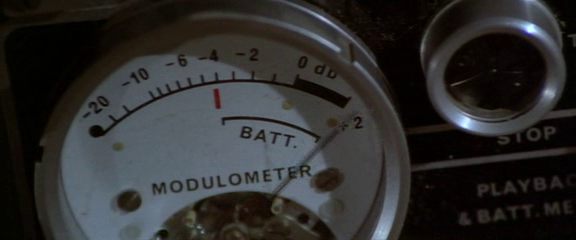
He goes to a bridge on the river at night, to get new wind. As he moves the mike around, recording, ambient noises rise and fall. The camera seemingly looks around, trying to find the source of the dominant sound before finally focusing on it. The serene uniformity of the soundscape – nothing particularly loud – is suddenly broken when we hear an explosion and then see a car hurtling down into the river. Every sound in this sequence is seeking its accompanying image – craving diegesis – before finding it and giving way to the next sound. Only the fully focused image of the source resolves the mini-pocket of suspense (“where does it come from?”) built around a ‘floating’ sound.

Terry jumps into the river and manages to rescue the girl in the passenger seat. The driver dies. It is only later that he learns who the dead driver is – Presidential favourite Governer McRyan, out for a fun night with a call girl. Convinced that the accident is a cover-up for an assassination Jack takes it upon himself to find and establish “the truth” – for which, he makes a sort of found-footage film from his audio recording and stills of the incident published in a magazine.

De Palma’s inspirations behind the film are well-known – Antonioni’s Blow-Up and Coppola’s The Conversation, as also the Zapruder film – but his thrust is in a whole different direction. The question here isn’t about the tendency of the medium to distort or hide the ‘essential information’ – like the noisy film stock/recording in Blow-up/Conversation¸ both of which become so open-ended when stripped down and amplified that one wonders if the mind is imagining things. De Palma makes it clear that McRyan has indeed been killed, so the drama for a good portion concerns the minutiae of Terry’s amateur filmmaking. In a reversal of roles with the Zapruder film what exists as primary document here is the sound of the incident. The image has to be constructed for Terry’s claims to be substantiated. He succeeds, sure, but at what cost?


What Terry believes in, of course, is a variation of the old wisdom about film editing – that it is only in the re-assemblage of shot footage that one finds meaning (or “truth”). In a world of uncommitted dime-a-day shlock he’s the last idealist, believing the medium must be put at the service of truth. What the guy doesn’t know is the other old adage – you can’t be in the business without giving up part of yourself. It is only through the loss of his naiveté – and the girl for whom he staked so much – that he completes the only missing bit in the sexploitation film: the scream. The relation has finally been reversed – if much of the film was a search for the perfect image by sound, the denouement has an image find the perfect sound it was looking for all along.

Sunday, 16 February 2014

The Rules of the Game: notes on Johnny Gaddaar


One persistent criticism of pastiche as a genre is how it really is about other works of art and therefore unrelated to reality; as Andrei T said, “Cinema uses your life, not vice versa.” Yet for something that is pure pastiche – nothing more than a series of quotations from the Sriram Raghavan canon – I find Johnny Gaddaar to be emotionally resonant in a strange way. And it isn’t a one-off impression. Having watched it about ten times by now, I’m still moved when Sheshadri (Dharmendra) crawls over to the tape-recorder to hear his dead wife sing after being gutshot. It is, like the rest of JG, yet another homage – a song from the early Dharmendra film Bandini – but one stamped with a precious sense of emotional experience.

That gets me thinking – how does Raghavan earn my emotional investment? The surfaces suggest otherwise. For one, the acting here is consistently hammy in keeping with the Vijay Anand tone. In the scenario leading up to Sheshadri’s murder, the line “shut up, you son of a bitch” is delivered so hilariously (cf. Dharmendra’s chinnery-sewing dog-blood-drinking days in the ‘80s) that it undermines the seriousness of the situation. And yet the murder ‘feels right’ because Raghavan knows how to switch moods – a pedestal fan provides the only ambient sound in tense dead-time (newspapers flutter) and then the ‘rupture’ occurs. But Raghavan doesn’t stop at that. The first thing Sheshadri hits when he tries to get to the tape-recorder is the fan, which falls with a loud clatter on the floor. This is the precise sort of consciousness about the medium’s plastic nature – and how to engage with it – that I wish more commercial filmmakers understood, given that they are in the best position to deal with plastic elements in the guise of ‘entertainment’.

How does Vikram (Neil Nitin Mukesh) get the idea of double-crossing? His girlfriend Mini (Rimi Sen) writes out the cash he’s going to make from a deal with lipstick on the bathroom mirror (they’re banking on it to ‘start a new life’), but she mistakenly writes the whole gang’s take instead of only his. Vikram corrects her. But later in the night he comes back to the bathroom to wash, having just had dinner while watching Parwana on TV. He looks into the mirror, the crazy Parwana plot fits in and he’s ‘sold’. Without quite understanding it the girl has set off her man into a bloody Macbeth-like quest for more than he wanted. (As if to validate my wild guesses, I found a basin filled with bloody water as a poster in Shardul’s office!)

But Vikram is not the only one falling back on Parwana. Prakash (Vinay Pathak) and his wife are watching it too in their home and she comments how no one could have foreseen in 1970 that the lanky awkward Bachchan – instead of sweet-faced Navin Nischol – would be the superstar. Prakash turns it into a wily excuse for ‘making the right decision at the right time’ and coaxes her into mortgaging her beauty parlour to raise extra cash for the deal. Same ‘reference’ but different people using it to different ends (both manipulative).

Making the right decision at the right time. Standing at the crossroads – the bifurcation between Pune and Goa, between a dirty scam and a clean life – Vikram wants to reconsider. Finding that he can’t take a definite call, he defers decision-making to a coin (who can you trust your conscience with but money?). Tails for a clean life, heads for the plot. First spin, tails. “Best of 3.” Second spin, tails. “Best of 5.” Third spin, the coin turns around. Fourth and fifth too, heads. Which is precisely when heads start to roll.

There’s a reference to Citizen Kane where a neglected wife plays jigsaw puzzle, but the more important debt might be to Welles’ method of cutting to the sound of the next scene while the image hasnt changed. This creates a sort of suspense through which the ‘drama’ of one scene segues into the other. Vikram is the only character for whom expressionistic sound design is reserved – as he stares into the lipstick writing on his mirror, a train passes by; then, sitting in Sheshadri’s house waiting for the other gang members to come – his plot exposed – the calling bell rings. In both these instances the sound is of horrors to come: a man hears more than what is real and in the present.

I can go on writing about how clever and ironic Johnny Gaddaar is, how every major plot point is coded in the colour red, how a crime caper like this is also a chronicle of three marital relationships – each of them telling – but that’s better left for you to find out.

Sunday, 19 January 2014

No Dumb Rocks: a little singsong on Routine Pleasures


Midway through Routine Pleasures, this exchange takes place…

[Gorin] The thing that amazed me is that you guys are running schedules for very, very long periods of time. I mean, once Corky has defined the great call board...
[Man] Mm-hmm.
[Gorin continues] it runs for one or two seasons, which is basically...
[Man] Pretty much the -
[Gorin] twelve months, no? I mean -
[Man] Yeah. Yeah. Maybe even longer. But you've got to remember it's - it's evolving all the time, for one thing. It's never quite the same.
And besides, the schedule isn't the whole story. I mean, the schedule says you run 10, 12 trains of an evening... you know, one direction or another at particular times. Well, there's a lot more activity than that... and, uh, that's really the fun of it all.
These trains go through at the same time all the time. You know when they're coming. So the other things that you do, you have to kind of fit it in between. That's part of the fun of it. For example, making switching moves and what not. Those you do differently each time.
[Gorin] So it's - that's what is difference... difference in repetition? I mean -
[Man] Yeah, yeah. The... so to speak, the schedule provides a matrix in which you do the fun part. Does that make sense?
[Gorin Laughs] Yeah. So the trains like, let's say, the Lark or the Delight are the permanent fixtures. They function like what, the landscape?
[Man] Almost, yeah. Call it temporal landscape. These things are going to happen at particular points in time. You know that. You have to work around it.

…and I start thinking this sounds familiar. But what really catches my attention are those two words sticking out from the rest: temporal landscape. My my, I think, the fellow doesn’t only know what drives him but also has the exact words to articulate his impulses. I’m beginning to grow jealous. I love this film, I tell myself, only I can’t place my finger on the why. It’s like that bit where the fellow explains the paint job on a train to Gorin and “at the end of it all, there’s only one thing left to say, "Good-looking train."”

Damn it, model railroad man! Damn it, Manny Farber! If only I could find my equivalent of temporal landscape or sinewy, life-marred exactness (“Manny, who in three words could pin down the way Cagney sliced through the space of a ballroom in Wellman's Other Men's Women…”)...

But maybe I better persist. If I sit down long enough and go through the motions… like writing down 10 sentences trying to say a thing without quite getting it… I might get it. (“For both Manny and the guys there was so much routine at the core of any flight of the imagination.”)

Sorry, I may be getting too ahead of the story. So like a dutiful Old Hollywood junkie, like in one of those movies by Wellman and Hawks that Gorin evokes incessantly, let me start at the beginning.

***
Farber (extreme left) and Godard: "old buddies" to Gorin
Jean-Pierre Gorin, one-time collaborator of Godard, came to the US in the mid-‘70s at the invitation of Manny Farber (a former film critic whose work from the ‘40s to the ‘60s remains vital and fresh today while Bosley Crowther has become a comic footnote on wikipedia). Farber was building up a visual arts department at the University of California, San Diego at the time. “The reading of his film criticism gave me a very different key to American cinema than the one I used in France, a way to ground it in the culture and its language, to pry it away from its own mythology.” Naturally Gorin was happy to shift base (Dziga Vertov Group had dissolved); excited and anxious in mapping the mythical land with his own images of it weaned through the movies and media. Part of his mission is to find out roots, the specific trills and cadences of a culture and understand identity – how much of an American had he become in the five years he’d spent in the country (“I wasn't French anymore, but I wasn't quite American either.”)? What does an “ex-Marxist” do with characters whose very existence is defined by their fascination with machinery and tools and the railroad – that trope of change from the westerns? These characters are the members of the Pacific Beach & West (PB&W) model railroad club – a group of middle-class homely types who gather every Tuesday on the Del Mar fairgrounds to be masters of, and slaves to, their miniature universe.

Routine Pleasures belongs at a glance to the genre of documentaries that is best exemplified by Errol Morris’ Gates of Heaven, or perhaps the Maysles’ Salesman – intimate portraits of the “simple folk” of small-town America that double up as sociological studies – but it combines the surface simplicity of those films with a formal approach that Gorin wears lightheartedly. There’s always the rhythm section of sly humour cutting through – the model landscape shot in extreme close-ups as if it were the real thing, played to a realistic soundtrack of trains and atmospheric minutiae, cutting from a woman sitting on a porch basking in the sun (as in Ed Hopper) to another woman frozen in the middle of a run to catch a departing car, her suitcase swaying back. And then Gorin does ‘long shots’ of the same landscape, from between which the “train people” (Cat People?) pop up Godzilla-like to dust up the tracks and do odd painting jobs.


And later I learned that they'd been hard at it since 1958... the time of De Gaulle's return to power and of my first stumble into politics.
Half the world away the train people had just been given a home on the Del Mar Fairgrounds... on the condition that they would have a show ready for the first fair.
And since then, every Tuesday night they had gathered to run trains... in this hangar on Jimmy Durante Boulevard across from the Bing Crosby Hall.
.
.
.
And it dawned on me that their layout was the only thing that had remained unchanged... in a landscape where corporate headquarters, malls and cities of 40,000-plus were popping up now by the month. If anything, they had a tale of permanence to tell.
Every now and then, the nostalgia bug bites. The men are united in their utter absorption in the world of trains, a shared camaraderie that is silent, bonds borne of working together to the same rhythm. Gorin wants to connect them to the train gangs from the ‘30s American films – maybe Bill Wellman’s Other Men’s Women – but he’s put on guard by Farber who admonishes him against nostalgia even as he is digging into his own childhood memories to paint expansive canvasses. "You are all Remembrance of Things Past. But they aren't your things and this isn't your past."
Movie house in shoe-box America/Remembrance of Things Past.
Gorin persists nonetheless. The club’s general manager’s calling card reads “Corky Thompson, train specialist”: the sort of name which “took me for a loop as if it had jumped out of a Howard Hawks movie... a name like Matthew Garth or Bud Kenley... a name that ties a knot under a personality... and that I saw somehow as the guarantee that I could pull a Howard Hawks of my own.” After all, how could he swim against the whole collective memory-churning of this bunch – guys who shot home movies of trains (in memory, Lumiere!) and remembered the “spot where 4449 was going upgrade with the diesel and dynamic braking…. and was workin' and slippin'”? It has to be a nostalgia film alright. The club had agreed to let Gorin film them if he promised to hand over unused footage so that they could make a film out of it. Money was never discussed. What good was it compared to the glorious sight of a train “pounding up the grade”?

Corky Thompson's home movies

Coincidence?
Gradually one sees the fine notes in their activity. Like so much of the best of Old Hollywood, it is both restricted and set free by the rules of the game. You repeat certain lines so that you can take off from there and explore the other things before coming back and hitting base. It’s a decidedly Manny Farber-ish style of doing things – the termite’s way of “gnawing at the borders” without realizing if it’s “chewing on the Sistine Chapel or an old hangar on the Del Mar Fairgrounds”.
Midway through this memory trip, Gorin switches from black-and-white (a conscious homage to the ‘30s films) to his version of Life in Technicolor when shooting the club in action – the cragged, rocky Western landscape through which the trains run bring to mind the spaces from John Ford Westerns and Minnelli’s Some Came Running even as its scale undermines the mythological underpinnings. “Somehow I'd managed to convince myself that they were offering me a small-scale epic. America under budget and in a shoe box.” The guys put Gorin in a toy Citroen – the car he actually owns – and move it around the landscape every Tuesday, leaving him “to dream on the inside”, showing him the sights. In a lovely show of solidarity with the unwavering realism of these guys’ imagination Gorin narrates – “One day I took Farber to the airport. He was carting away to New York a load of paintings for a show. On the way, we got stopped at a crossing and watched an endless freight pass by.” – to this.


Gorin and Farber in the Citroen, waiting.
But once the clocks are out for a break, Gorin reverts back to monochrome. Time shifts gears and all you’ve got left is the past.

***

But how had Gorin come to be here at all?

One day I was looking over some Barney Googles. It was one of the tracks Farber had sent me to. And it hit me that if there was one trick that I'd learned from him it was an age-old one. When you want to say where you stand in a landscape, you draw an "X." Two lines crossing at a single point.


This other line – the one that may in fact have sent him to the train people – is Farber and his paintings, “Birthplace: Douglas, Ariz.” (Oil on board, 1979 / 44.5 in. x 53 in.) and “Have a Chew on Me” (Oil on board, 1982 / 58 in. x 134.5 in.). Canvasses painted flat on a table top, they have the forced perspective of a bird’s eye view with objects incongruously laid out flat or at an angle – especially in Birthplace, a sort of map of Farber’s hometown with its history littered all around in almost inconsequential details.

There were memories
that came back from the familial past...
and took the form
of an oversized fire sale sign...
next to a toy house...
a reminder of the time his mother
had torched their store...
and sold off the damaged goods
to follow his oldest brother...
to his campus life in Berkeley.

There were echoes of headlines...
in a group of lead toy gangsters
in the right-hand corner.
Some shoot-out memory, maybe,
between company toughs and miners...
during the copper wars.
Blowup from 'Birthplace: Douglas, Ariz.'

Blowup from 'Birthplace: Douglas, Ariz.'

Blowup from 'Birthplace: Douglas, Ariz.'

And so often, just as Gorin is about to round off a painting, something in the margins makes him re-evaluate everything.

With Farber, you were always
in the thick of things.
It was the same thing
that he was saying over and over -
- That it - life - wasn't too big a deal...
and that it shouldn't be painted like one...
that we're all like bit players
in a Preston Sturges movie...
ready to testify in front of a small-town jury...
in terms whose relevance
would escape everyone but ourselves.

I guess – with a final swell of music – that is how this film is to me.
Sunday, 12 August 2012

How cheap is human life? - on Gangs of Wasseypur


First of all, the confession: I enjoyed seeing both parts on Gangs of Wasseypur, the second half more than the first. I admire the craft that went into the film - the flawless lighting and cinematography, the uniformly good acting from the cast, how it plays around with music and countless other details. Yet I find it problematic to accept. Or perhaps, because of it.

Kashyap has always been some sort of a prankster: whenever he can, he'll hold up the narrative for a while to deliver a joke, an ironic detail or something to break up dramatic tension (e.g. the haldi gag in Dev D). This works brilliantly for me when it is balanced with a genuine emotional core - as in Dev D - or when the world within the film is sufficiently outre to suspend expectations of reality, as in No Smoking. But with Gangs, he's made the only film in his career where the explicit intention is to blow up narrative continuity with a series of jokes.

I don't find this anarchic tendency problematic in itself. Bunuel did the same thing in his later films with Jean Claude-Carriere (for example in The Discreet Charm of the Bourgeoisie) and I love him precisely for this subtle demolition of audience expectations. The trouble with Kashyap is that he's using humour in the same amoral way as Tarantino, only without the edge.

To elucidate with an example: the murder of Sultan, which recalls something of the Bunuel spirit. Kashyap sets up the scene as a joke - the coordinator of the hit job is having trouble tying his pyjamas while he's on the phone line with three different people - and for a moment we assume that Sultan is going to slip by in all this chaos. But the plan falls into place just in time and Sultan is murdered viciously - a sudden change in tone which ends up implicating the audience for forgetting that we're ultimately laughing about murder. This unease is why Tarantino works in films like Inglourious Basterds, the self-awareness that violence is fantasy.

By contrast, most of the other killings in the film are played out rather routinely without any emotional investment of the audience in what's going on (and Yashpal Sharma is always at hand to suitably play the ironic brass band troubadour). We enjoy the spectacle but don't feel anything at all - something which reaches its apotheosis in Ramadhir Singh's climactic death. The whole thing is pulled off so bloody impressively that you want it a second time. The difference in this and the Sultan scene is that there is nothing in Kashyap's attitude which indicates that he doesn't share the let's-have-fun-shooting-some-more feeling. It's this invitation to witness full-blooded revenge in glorious slow-motion with accompanying hip techno music that repels me (coincidentally Jim Emerson recently wrote on why he doesn't consider revenge a good plot device). A sort of shirking away from taking a moral and emotional ground, as if that's too hip and uncool. Lest anyone forget, this is the director of Gulaal we're talking about - a political film considerably drowned in pathos.

Which brings me to my theory. The only way GoW makes sense to me is as Kashyap's own vengeance saga. It's like he wants to take us on for completely ignoring That Girl in Yellow Boots (his most emotionally honest film) and show that he can make a blockbuster hit - by twisting and playing around with Bollywood's prized conventions - delivering the ultimate abstruse masala film.

So far so good. Now that he's had his field day, will he get back to the Yellow Boots zone again? Or at least the Dev D one?

Friday, 10 August 2012

Circling around the past - Vertigo

In the light of the recently conducted Sight & Sound 2012 poll results, I decided to see Vertigo again. While my original idea was to write something comprehensive on it - the film has been swimming around in my mind for some personal reasons - I've decided against it because I find Chris Marker (a master who recently died) has already said nearly everything I wanted to. In this essay.

Conventionally, the film has always been read from Scottie's perspective. I feel it is as valid from Judy's. Both of them independently think that they can bury the past. Both are consumed in it. The film's just so goddamned fatalistic and cruel. As is life.

***

Be kind, rewind!


***

Adam Gopnik also has a wonderful essay that deals indirectly with Vertigo's themes. Many thanks to Jai, from whom I came to know of it.

Monday, 6 August 2012

Escapism in cinema, baa Kaushik keno Q

In the popular consciousness, "serious films" (or "festival films") are always cracked up to be rooted in reality. One tends to divide cinema into two mutually exclusive boxes - that which is meant to provoke thought and that which helps once escape from sordid reality into projected fantasies.

But then Gandu comes trotting along happily and messes things up. All attentions focussed strongly on its taboo-breaking full-frontal scene, few people - next to no one - seems to notice this "paradigm shift". A complete break with our "parallel" film culture: which has always been strongly grounded in faithful depiction of some sort of reality, even in the formalist works of Kaul and Shahani. (Kamal Swaroop's surrealist Om-Dar-Ba-Dar is the only exception.) The most persistent criticism of the film is its haywire narrative structure - most people I know who have seen the film couldn't figure what it was about and proceeded to dismantle it from that point on. 

This inspite of the explicit hallucinogen use in the film - sign enough to resign oneself to the fact the film is supposed to be very much like an drug-trip. In a talk by Q I attended, he revealed that the dhatura scene was shot in a time of deep self-doubt regarding his place as a film-maker. Relying mostly on instinct while shooting (without a script, like most of the film), he shaped the scene largely while editing it - retaining the free-associative sensory overload one experiences in a trip. It might be argued that the sex with the kitten never really happened except in Gandu's drug-addled mind. The use of lurid, vivid colour certainly hints at that - especially when compared to Q's use of black-and-white for the rest of the film (which he calls the film's surviving link to Bengali political films of the past).

Q is open about his post-modern influences and posits that Gandu is in part about the effect of digital technology on our lives. The significance of virtual avatars, proliferation of shit and the increasing difficulty to hold on to traditional notions of good and bad in the context of internet - all of these find a way into his film. One reason why I find it difficult to judge it myself - though I understand something of what it is trying to say - is because the critical apparatus I usually employ is useless here; the film has absorbed its criticism into itself.

The elitist notion brewed in intellectual circles is one of a commercial cinema for the proletariat: meant for them to escape the drudgery of their existence. Bollywood practically thrives on this streamlined notion of what is escapism, an idea it has succeeded in embedding into the popular consciousness. What these intellectuals don't mention - even though they experience it themselves - is how a lot of "committed cinema" functions the same way for them. In a world that forces a certain sort of lifestyle upon urbane educated people, it is hard even for the genuinely caring to get out of their comfort zones and do something. By living a proxy life amongst people who are real, and emotionally connecting with their plight, they (bourgeois intellectuals) seek catharsis. An escape from the routine-ness from their lives. Their stuff of fantasies might not be gauche designer-clad cavorting in exotic locations - perhaps a more sophisticated liberal outrage against the hardships of Iranian women, for example - but it's a fantasy nonetheless. In case I seem to be pointing fingers, I'll admit it applies to me too (hence this post).

I love Calvin and Hobbes for several reasons, but the biggest might be Watterson's realization that the most interesting parts of our lives are lived inside our heads. Hobbes talking, joking and fighting with Calvin isn't a conceit, it's an essential need in Calvin's life (who is essentially lonely and friendless, if you've noticed). One needs an alternative identity to get by.

Like Q does. Imagine a guy named Kaushik Mukherjee gleefully rapping "nada nada Horihor, khada tor bada!" ("shake it, shake it, Horihor!"). Doesn't work. Too much cultural baggage to allow one to be an iconoclast. Q. Non-descript. Enigmatic. Now you can do what you want!

Q performing with Gandu Circus in The Basement, Kolkata. Photo by Shovon Ray.

Saturday, 28 July 2012

Harud


What is true evil? The trouble I had with the post-Dark Knight tom-toming of the Joker as a representation of True Evil is this vision of villainy as something larger-than-life, the work of a single man terrorising a whole city. Schindler's List ends with with Oskar Schindler delivering an impassioned speech to Nazi soldiers to go back home to their families. As with everything Spielberg, it promotes a sugarcoated vision of benevolent humanity - slightly led astray by the provocations of that epitome of True Evil, Herr Hitler. And yet, evil as I and most of us know it is banal and mundane - mostly a result of being trapped in the status quo - the evil of conformity and unquestioning acceptance.

There are several reasons why I think that Harud (trailer) might be the best political film to come out of India in quite some time. But the one reason on the top of my mind is this - it gets the nature of villainy right. In its repeated shots of rifle butts ominously hovering over Kashmir's everyday life it captures the humiliation that every Kashmiri must face without relief.

There are other things Harud gets right - its deliberate eschewing of historical explanations, and equally its safe distance from Bollywood's hyper-real aesthetic. The strength of Harud is in its lack of melodrama, its aesthetic restraint that mirrors the interiority of the characters - so that when the father breaks down mid-prayer or the mother grieves her dead son, it strikes home with an intensity that those long bouts of suppressed emotion withheld. It equally draws power from a carefully constructed sound design - the crackle of police radios, the wail of a siren, the clanging of a bicycle, and that final cathartic burst of music (which left me silent).

The film is in theatres for at least a week - if you're lucky enough to be in Mumbai, Delhi, Bangalore or Ahmedabad - so catch it while there's still time.


Harud (2010)
Dir.: Aamir Bashir
Prod.: Aamir Bashir, Shanker Raman
Screenplay: Aamir Bashir, Shanker Raman, Mahmood Farooqui
Shot by: Shanker Raman
Edit: Shan Mohammed
Sound: Nakul Kamte
Cast: Shahnawaz Bhat, Reza Naji, Shamim Basharat, Salma Ashai, Umar Bhat, Showkat Magray